
Last updated Nov. 21, 2026
Low water pressure in a Detroit house usually comes from one of three places: a clogged faucet aerator or valve inside your home, a problem on your own service line or plumbing, or work and water main breaks on the city side. A two-minute check of which taps are weak, and whether your neighbors have the same problem, tells you which one it is and whether to grab a wrench, call a licensed plumber, or report it to the Detroit Water and Sewerage Department (DWSD) at 313-267-8000.
This Metro Detroit troubleshooting guide covers weak flow at the kitchen sink, no water pressure in the whole house, water not coming out of the faucet, and black stuff in the water, plus where the city’s responsibility ends and yours begins. It’s part of our winter home series: practical Detroit news you can use the same day.
In this guide
- Quick diagnosis table
- Step 1: One faucet, the whole house or the whole street?
- Low water pressure in the kitchen sink or one faucet
- No water pressure in the whole house
- Water not coming out of the faucet at all
- Black stuff coming out of the faucet
- Water main breaks: how to report them to DWSD
- Lead service lines and Detroit’s replacement program
- City vs. homeowner: who fixes what
- FAQ
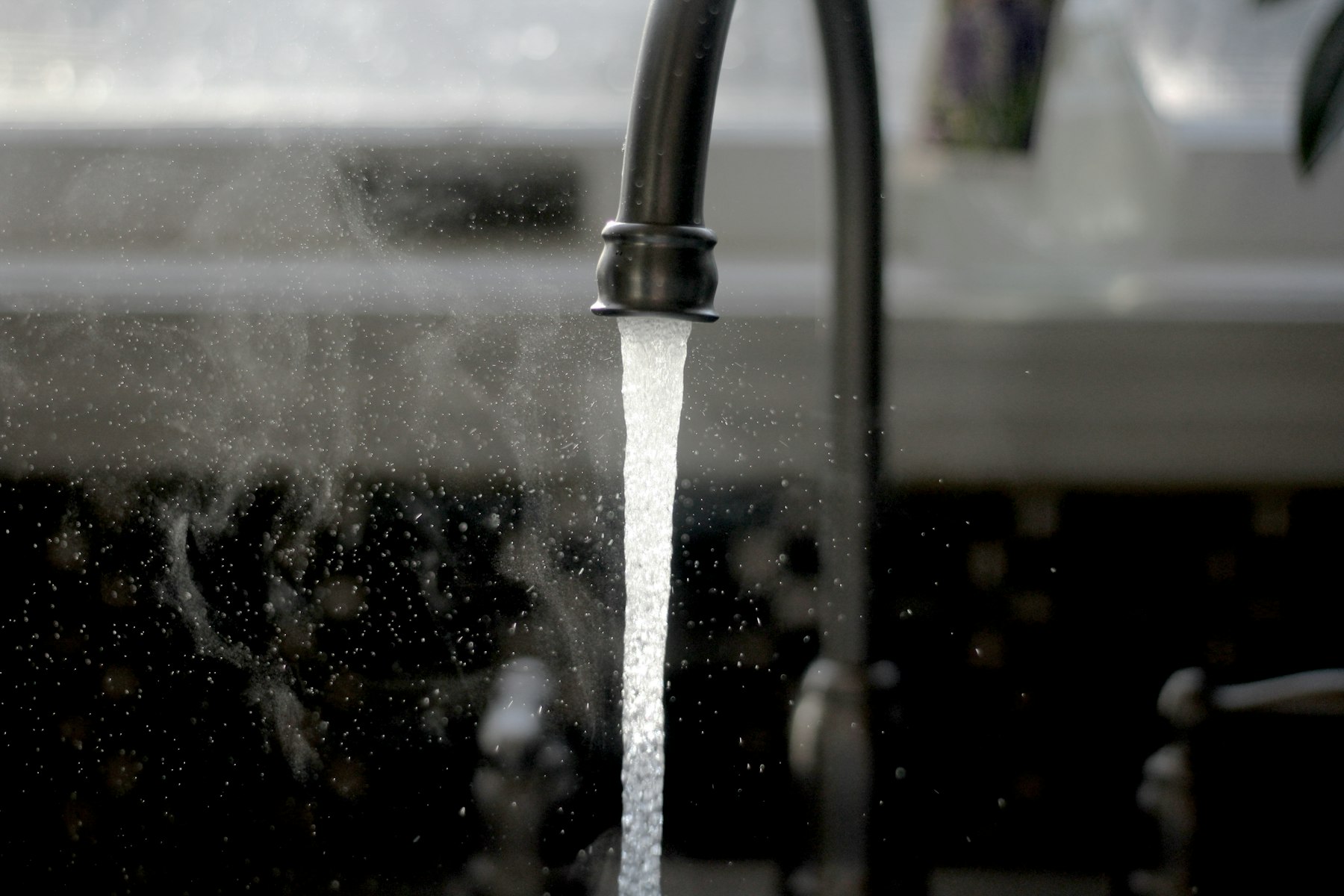
Quick diagnosis: what’s causing low water pressure in your house?
| What you notice | Most likely cause | What to do now | Who to call |
|---|---|---|---|
| One faucet is weak, others are fine | Clogged aerator, worn cartridge, or a half-closed shutoff valve under the sink | Unscrew and rinse the aerator; open the supply valves fully | Usually DIY; plumber if a cartridge or valve is failing |
| Only the hot water is weak | Water heater sediment or a broken dip tube; partly closed valve at the heater | Check the heater’s cold inlet valve; flush per the manufacturer | Licensed plumber |
| Every tap is weak, neighbors are fine | Main shutoff not fully open, pressure regulator, hidden leak, old galvanized pipe, or a frozen section | Check the main valve and meter area; look for wet spots | Licensed plumber |
| Every tap is weak or dry, neighbors too | Water main break or city work | Don’t open more taps; report it | DWSD 313-267-8000, option 4, or the Improve Detroit app |
| No water at all after a hard freeze | Frozen pipe | Shut the main, thaw safely, watch for leaks | Plumber if you can’t find or reach the frozen section |
| Black or gray specks in the water | Breaking rubber washer or gasket, filter carbon, or debris stirred up in the main | Run cold water 1-2 minutes; clean aerators | DWSD if it’s every cold tap and doesn’t clear |
Step 1: Is it one faucet, the whole house, or the whole street?
This is the question that decides everything else, and it takes a couple of minutes.
- Test several taps. Turn on the kitchen sink, a bathroom sink, and a tub, cold side first, then hot.
- Compare hot and cold. If only hot is weak, the problem is almost always the water heater or its piping, not the city supply.
- Check an outdoor spigot or laundry tub if you have one. Strong flow there but weak flow upstairs points to your interior plumbing.
- Ask a neighbor or two. If they also have weak or no water, it is likely a main break or DWSD work, and you should report it rather than call a plumber.
- Think about timing. A sudden drop overnight during a deep freeze suggests a frozen pipe. A slow decline over months suggests buildup in old pipes or fixtures.
- Get a number if you can. A water pressure gauge that threads onto a hose spigot or laundry connection, sold at hardware stores, gives you a reading to share with a plumber (see the pressure guidance below).
Low water pressure in the kitchen sink or one faucet
When only one fixture is weak, the fix is usually at that fixture. Work through these in order, from easiest to hardest.
Clean the aerator
The aerator is the small screen at the tip of the faucet spout. Grit, mineral flakes, and bits of old rubber collect there and choke the flow. Unscrew it by hand (wrap it in a cloth if you need pliers so you don’t scratch the finish), rinse the screen, and screw it back on. DWSD itself advises removing the aerator monthly to rinse out debris, so this is routine maintenance, not just a repair.
Open the shutoff valves under the sink
Look under the sink for the two small supply valves. After a repair or a new faucet install, it is common for one to be left partly closed. Turn each counterclockwise until it stops. If a valve won’t move or starts to drip when you turn it, stop and call a plumber; old valves in older Detroit homes can crack when forced.
Check the cartridge and supply hose
If the aerator is clean and the valves are open, the faucet cartridge may be clogged or worn, or a flexible supply hose may be kinked. Cartridges are model-specific; if you’d rather not take the faucet apart, call a plumber.
No water pressure in the whole house
If every tap is weak but your neighbors are fine, the cause is on your property: a valve, a regulator, a leak, or the pipes themselves. These four account for most answers to “what causes low water pressure in a house” when the street’s supply is normal. Here is what to check.
The main shutoff valve
In many Detroit homes, the main shutoff sits in the basement where the service line comes through the foundation, usually near the water meter. If it was turned recently (for a repair, or by a previous owner), it may not be fully open. A gate valve with a round handle should be turned counterclockwise until it stops; a lever-style ball valve is fully open when the handle runs in line with the pipe. Our guide to shutting off water and handling frozen pipes shows how to find and operate this valve, which every household should know before winter.
A pressure-reducing valve
Some homes have a pressure-reducing valve (PRV), a bell-shaped fitting just after the main shutoff. When one fails, pressure can drop throughout the house. Most plumbing codes require a PRV where supply pressure exceeds 80 psi, and U.S. Department of Energy building guidance recommends static pressure of no more than 60 psi inside a home. A plumber can test your pressure with a gauge and adjust or replace the valve.
A hidden leak
A leak steals pressure and runs up your bill. With every fixture off, watch the water meter: if the dial or low-flow indicator keeps moving, water is going somewhere. Check the floor under the water heater, running toilets, and outdoor spigots. Water pooling in the yard between the sidewalk and your house can mean a leak in your service line. Water on the basement floor near drains is a different problem; see our basement flooding guide for Detroit if that is what you’re dealing with.
Old galvanized pipes
Many older Detroit houses still have galvanized steel water pipes. Over decades, rust builds up inside them and narrows the opening, so pressure declines slowly, often worst on upper floors. You may also see brownish water when a tap first opens. Cleaning won’t reverse this; the long-term fix is repiping with copper or PEX by a licensed plumber with a city permit.
Hot water only
If cold water is strong and hot is weak everywhere, look at the water heater. Sediment in the tank, a partly closed cold inlet valve on top of the heater, or a deteriorating plastic dip tube can all restrict hot water flow. A failing dip tube sheds small white or gray plastic bits that clog aerators and showerheads. Flushing and dip tube replacement are jobs for a plumber unless your heater’s manual walks you through them.
Water not coming out of the faucet at all
No water at all usually means one of three things: a frozen pipe, a closed main valve, or a city-side outage.
- After a cold snap: Pipes along exterior walls, in crawl spaces, and near basement windows freeze first. If some taps work and others don’t, a section of pipe feeding the dry taps is likely frozen. Shut off the main before thawing, because a frozen pipe may have split and will leak once it thaws. Never use an open flame to thaw pipes. The frozen pipes guide covers safe thawing step by step.
- If your neighbors are dry too: It is likely a main break or planned work. Report it (see below) and keep a few faucets closed so sediment isn’t pulled into your plumbing when service returns.
- If only your house is dry and nothing is frozen: Check that the main shutoff is open. If it is, the problem may be at the curb stop or in your service line. Call DWSD to confirm whether there is work on your block before paying for a plumber.
On city water, taps generally keep working during a power outage because the system is pressurized by the utility rather than by equipment in your house; homes with a well or booster pump are the exception. Our Detroit power outage guide explains toilets, showers, and water use when the lights go out.
Black stuff coming out of the faucet
Black or dark specks usually come from something breaking down inside your own plumbing, not from the city’s water. Where they show up tells you the source. This table draws on troubleshooting guidance published by large public water utilities, including Milwaukee Water Works and the Portland Water Bureau.
| Where you see it | Likely source | What to do |
|---|---|---|
| One faucet only | A disintegrating rubber washer or gasket, or corrosion in that fixture | Run the water a few minutes, clean the aerator; replace the washer or call a plumber if it returns |
| Hot water only | The water heater (sediment, aging parts) | Follow the heater manufacturer’s maintenance steps or call a plumber |
| Toilet bowl only | A breaking-down tank float or flapper, especially with in-tank cleaner tablets | Replace the part |
| After installing a new filter | Carbon fines from the filter cartridge | Flush the filter per its instructions |
| Every cold tap, suddenly | Sediment stirred up in the water main by a break, hydrant use or construction | Run cold water 1-2 minutes; if it doesn’t clear, report it to DWSD; clean all aerators afterward |
A simple test: run a cold tap for one to two minutes. If the water clears quickly, the cause is most likely in your home’s plumbing. If it stays discolored at every cold tap, call DWSD. If you have a lead service line and see unusual particles, ask DWSD about testing (details below) rather than guessing.
Water main breaks: how to report them to DWSD
Report a suspected water main break, street flooding, or loss of water on your block to DWSD at 313-267-8000 (press option 4 for water and sewer emergencies) or through the Improve Detroit mobile app. DWSD’s maintenance and emergencies page lists the same number for main breaks, street flooding, and sewer backups.
Breaks can come in clusters. On a single day in late January 2026, the city logged 51 water main breaks, according to WDIV. When a main fails nearby, you may notice a pressure drop first, then cloudy or gritty water once repairs finish.
- When you call: give the address or cross streets, what you see and how long it has been going on.
- After service returns: run cold water at the lowest tap in the house until it runs clear, then clean every aerator and showerhead screen, since loosened sediment settles there.
- Watch for advisories: if DWSD issues a boil water advisory for your area, follow its instructions until it is lifted.
- Sewer backup damage: DWSD notes that state law requires a written claim to the department within 45 days of discovering the damage.
Lead service lines and Detroit’s replacement program
Many older Detroit homes are still connected to the water main by a lead service line, and DWSD replaces them with copper at no charge to the owner, with the owner’s or occupant’s permission. According to DWSD, the department has replaced more than 15,800 lead service lines since 2018, paid for through its capital program and state and federal funds. The city’s Lead Service Line Replacement Program page notes that state law requires all lead service lines to be replaced by 2040.
A lead line doesn’t, by itself, cause low pressure, but replacement work on your street can temporarily stir up sediment and clog aerators. More importantly, it changes how you should use your water.
- Check your line: use the city’s service line map at detroitmi.gov/waterservicelinemap.
- Get on the list: take a photo of the pipe where water enters your basement or crawl space and add your home to the replacement wait list at detroitmi.gov/LSLR.
- Request a lead test: through detroitmi.gov/leadsafe or the Detroit Lead Safe Resource Line, 313-267-8000, option 7.
- Flush before drinking: DWSD advises that if water has sat for several hours, homes with a lead service line should run it for at least five minutes; homes without one, 30 seconds to two minutes, or until it turns cold.
- Clean aerators monthly, as DWSD recommends.
City vs. homeowner: who fixes what
DWSD is responsible for the water mains and the service line up to the curb stop, the turn-on/off valve near or at the sidewalk. The property owner is responsible from the curb stop into the house, plus all interior plumbing. If the private portion fails, DWSD says the owner must hire a licensed plumber and pull the proper city permit.
| Part of the system | Responsible | Who to contact |
|---|---|---|
| Water main under the street | DWSD | 313-267-8000, option 4, or Improve Detroit app |
| Service line, main to curb stop | DWSD | 313-267-8000 |
| Service line, curb stop to house | Property owner | Licensed plumber (city permit required) |
| Main shutoff, meter area pipes, interior plumbing, water heater, faucets | Property owner | Licensed plumber |
| Lead service line replacement | DWSD program, with permission | detroitmi.gov/LSLR |
Renters
Tell your landlord about low pressure or a leak in writing, with the date and what you’ve checked. Cleaning aerators is fine; leave valves, the water heater, and pipes to the owner’s plumber. Block-wide outages can be reported to DWSD directly.
Help with repairs and leak bills
DWSD lists a few options on its plumbing assistance page. Low-income customers with a leak or high water use can receive a water audit and minor home plumbing repairs through the DWSD Lifeline Plan, as long as funding is available. Customers who had a leak can request a DWSD Leak Credit through the Customer Self-Service Portal once repairs are made. Call 313-267-8000 to ask what you qualify for.
Prices for valve, regulator, or repiping work vary with the house, so get at least two written quotes, confirm the plumber is licensed, and ask whether the price includes the city permit.
This guide is general information, not plumbing or legal advice. For repairs on your side of the curb stop, use a licensed plumber; for a flooding street or a suspected main break, call DWSD; if water is near electrical outlets or panels, stay clear and call an electrician or 911.
FAQ
Why is the water pressure low in my house all of a sudden?
A sudden drop at every tap usually means a nearby water main break, city work, a frozen pipe, or a valve that was bumped closed. Ask your neighbors first. If they have the same problem, report it to DWSD at 313-267-8000, option 4. If it’s only your house, check the main shutoff and look for frozen or leaking pipes.
What is normal water pressure for a house?
U.S. Department of Energy building guidance recommends static pressure of no more than 60 psi in a home, and most plumbing codes require a pressure-reducing valve when supply pressure is over 80 psi. A plumber can measure your pressure with a gauge on a hose spigot or laundry connection.
Who fixes the water pipe between the sidewalk and my house in Detroit?
The property owner. DWSD maintains the line up to the curb stop near the sidewalk; from there into the house is the owner’s responsibility, and repairs require a licensed plumber and a city permit. The exception is lead service lines, which DWSD replaces through its program with the owner’s permission.
Why is there low water pressure in my kitchen sink only?
When the rest of the house is fine, the cause is almost always at the sink: a clogged aerator or pull-down spray head, a half-closed supply valve underneath, or a worn cartridge. Rinse the aerator first, then open both valves fully. If that doesn’t help, a plumber can replace the cartridge or supply hoses.
Is black stuff coming out of my faucet dangerous?
Most often it is crumbling rubber from a washer or gasket, filter carbon, or sediment, which is a plumbing problem rather than a health emergency. If it appears at every cold tap and doesn’t clear after a couple of minutes, call DWSD. If your home has a lead service line, request a lead test through the city.
The bottom line
Start small: test several taps, compare hot and cold, and ask a neighbor. A clogged aerator or half-closed valve is often the culprit and costs nothing to fix. Whole-house problems on your side of the curb stop belong to a licensed plumber, and anything affecting your block belongs to DWSD at 313-267-8000. Save that number in your phone before the next deep freeze.
Detroit Weekly News updates this guide as DWSD programs and contacts change. For more Detroit news, home guides, and city updates, see our local Detroit news briefing archive.
Leave a Reply