
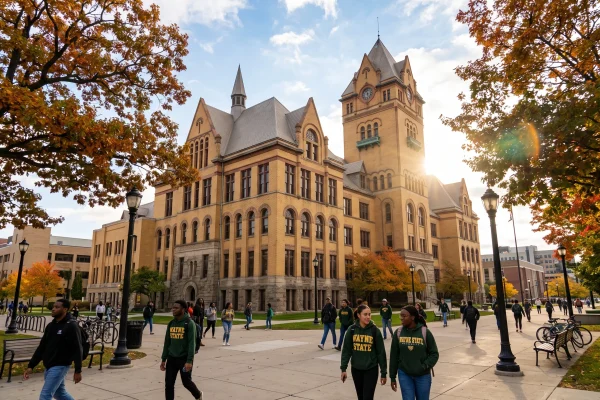
Wayne State University Detroit is the name most people think of when they picture a large, public, research-focused campus inside the city itself. It sits in Midtown, enrolls roughly 23,800 students by the latest official count, and offers everything from first-year undergraduate majors to doctorates, a medical degree and a law degree. Among universities in Detroit, nothing else comes close in size. Among colleges in Detroit, Michigan more broadly, it is one of the few places where you can begin a bachelor’s degree and finish a professional one without ever changing zip codes.
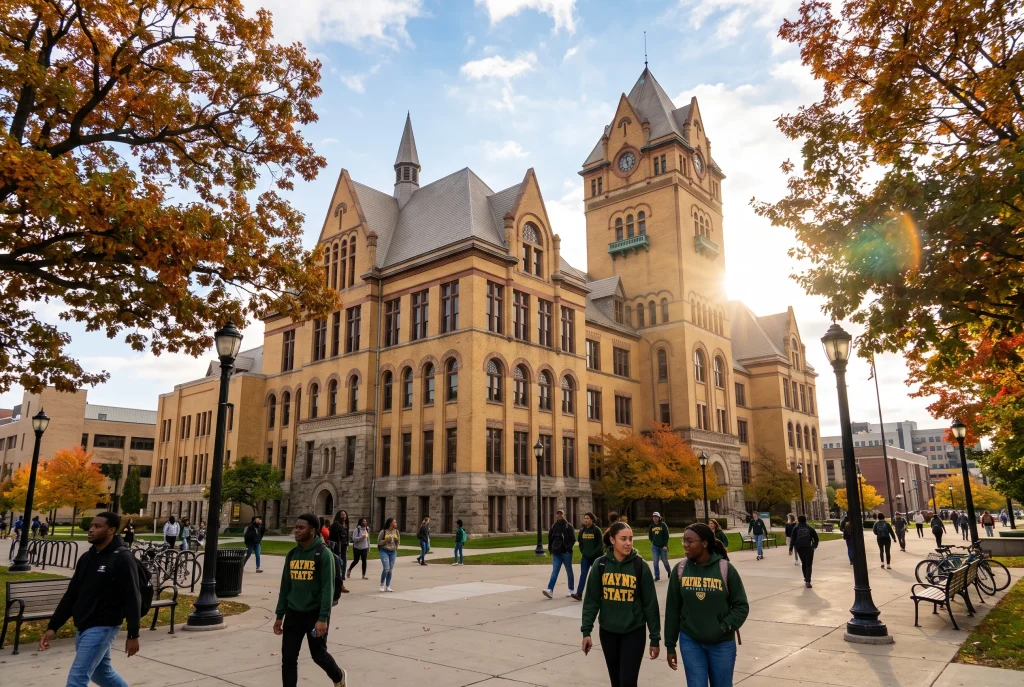
This guide goes deep. You will find the history, the major programs, a sober look at rankings, how tuition and aid work, the application process, campus and student life, safety, and who the school actually suits. Wherever a number changes every year, I link the official page instead of printing something that could be stale by the time you read it.
Good for: students who want a public, research-intensive university with strong medical, engineering, business, law and urban-focused opportunities in Midtown Detroit.
Wayne State at a Glance
| Detail | What to know |
| Location | Midtown Detroit, Michigan |
| Type | Public research university |
| Founded | 1868 as the Detroit Medical College; renamed in 1956 |
| Schools and colleges | 13 |
| Academic programs | More than 370, from bachelor’s degrees to doctoral and professional degrees |
| Enrollment | 23,803 students (17,838 full-time and 5,965 part-time), per the most recent official reporting |
| Undergraduate acceptance rate | 81.2% |
| Research status | Carnegie “very high research activity” (R1), retained in 2025 |
| Athletics | NCAA Division II, the Warriors |
| Where to verify live details | wayne.edu and the links throughout this article |
What Makes Wayne State University Different?
Plenty of schools say they are “in the city.” Wayne State actually is. The campus runs through Midtown, close to hospitals, museums, offices and the Cultural Center, so a morning lecture and an afternoon internship shift can happen without leaving the neighborhood.
If you are asking what Wayne State is known for, three things come up again and again. The first is the setting, which I just described. The second is range. The university says it has 13 schools and colleges offering more than 370 programs. That is a lot of room for someone who has not settled on a major, or who changes their mind in sophomore year (plenty of people do). Medicine, engineering, business, law, nursing, pharmacy, education, fine arts and social work all live under one name.
The third is research with a purpose. Much of it is aimed at problems that Detroit and cities like it live with every day, including health disparities, transportation, technology and urban policy. That gives the school a practical, applied feel. It also helps explain a number the university likes to share: the university has reported that nearly 75 percent of its roughly 313,000 living alumni stay and work in Michigan, so the network is local and deep.
Put together, Wayne State treats Detroit as a working lab instead of a backdrop.
Wayne State University History
Wayne State began in 1868 as the Detroit Medical College, started by a group of Civil War doctors who wanted better medical training in the city. For decades the institution grew in pieces. A teacher training school here, a junior college there, an engineering college later on. In 1933 several of these were joined as the Colleges of the City of Detroit, and in 1934 the combined institution became Wayne University.
The last name change came in 1956, when Michigan lawmakers made it Wayne State University.
That timeline matters because it follows the city’s own growth. As Detroit filled with factory workers and their families, the university expanded to teach them, treat them and eventually research the problems they faced. The first doctoral programs were authorized in 1945, and by the 1990s the Carnegie Foundation had recognized it as a top-tier research institution. The university’s history page lays out the full timeline, and it describes a school that has grown into one of the 50 largest public universities in the country.
Academics and Popular Programs
Wayne State University programs span nearly every field a student might consider, so it helps to look at the big clusters first. Program names, requirements and online options do change. Treat what follows as a map, not a menu, and browse all Wayne State academic programs for the current list.
The directory shows undergraduate, master’s, doctoral and professional degrees, plus certificates. If you are hunting for Wayne State University majors, the directory lets you search by field. It is far more reliable than any blog post, mine included.
Wayne State University Medical School and Health Sciences
The medical school is probably the best-known piece of the whole university, and the roots go straight back to the 1868 founding. The School of Medicine describes itself as the only medical school in Detroit and says roughly 40 percent of Michigan’s practicing physicians have some training from Wayne State. The most recent class profile on the school’s site, for the class of 2029, lists 299 matriculants chosen from 10,438 applications.
Outcomes data is worth a look too. The numbers for the class of 2026 are strong. Of the 285 senior students who took part in Match Day, 99 percent matched into residencies, well above the 93.5 percent national average. Internal medicine drew the most graduates (53 students), followed by anesthesiology (28) and family medicine (28). Because the university sits beside the Detroit Medical Center, students in medicine, nursing, pharmacy and allied health have clinical settings close by. The Eugene Applebaum College of Pharmacy and Health Sciences and the College of Nursing are part of the same health-focused side of the university.
Medicine is also one of the hardest tracks to get into. Treat it as a long-term goal and read the School of Medicine’s admissions facts early.
Wayne State University Engineering and Technology
Engineering here sits in a region built on automotive and manufacturing work, and the college leans into that. The James and Patricia Anderson College of Engineering lists undergraduate programs across three broad groups.
Engineering majors:
- Biomedical engineering
- Chemical engineering
- Civil engineering
- Electrical engineering
- Industrial engineering
- Mechanical engineering
Technology and construction programs:
- Electrical and electronic engineering technology
- Electromechanical engineering technology
- Mechanical engineering technology
- Welding and metallurgical engineering technology
- Construction management
Computing majors:
- Computer science
- Information technology
- Computer technology
There is also a co-op program for gaining work experience during your degree, and in a city full of automotive, mobility and manufacturing employers, that can be the difference between a resume with one line and a resume with a story. Details live on the college’s co-op page, and you can compare majors on the undergraduate programs page.
Business
The Mike Ilitch School of Business offers undergraduate and graduate study, including an MBA with online components. Business areas students typically look for include:
- Accounting
- Finance
- Marketing
- Management
Check the program directory for the exact majors and concentrations currently offered.
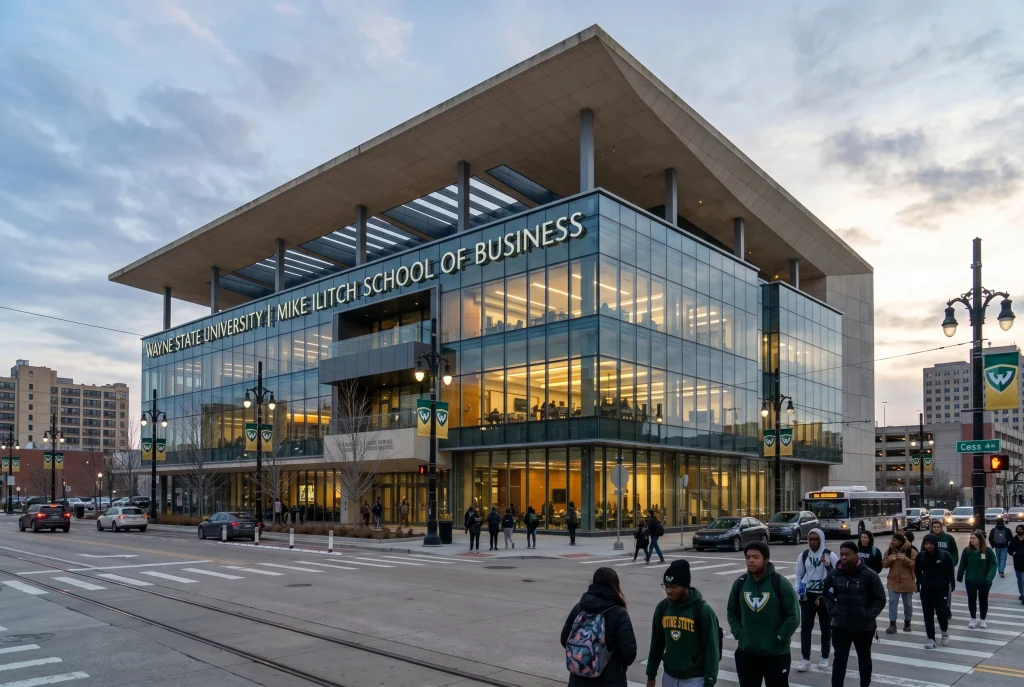
The location helps. Downtown employers, health systems and manufacturers are a short trip away, which makes internships easier to line up than at a campus an hour from the nearest office tower.
Wayne State University Law School and Public Service
Wayne Law is the university’s professional law school, and the school says it has been climbing national lists. According to the law school, U.S. News ranked it No. 62 for 2026-2027. The School of Social Work and public affairs offerings feed local nonprofits and government agencies, and the university says its social work program sits in the top 20 percent nationally according to U.S. News.
Courts, agencies and community organizations are all nearby, so location matters here more than almost anywhere.
Arts, Humanities, and Communication
Not everything is pre-professional. Two colleges carry most of this work:
- College of Fine, Performing and Communication Arts: music, theatre, dance, film and journalism
- College of Liberal Arts and Sciences: the humanities, social sciences and natural sciences
The Irvin D. Reid Honors College gives high-achieving students a smaller community inside a large university. Detroit’s creative scene is right outside the door.
Wayne State Graduate Programs
Graduate study is a core part of Wayne State’s identity. The Graduate School oversees master’s and doctoral education across fields, and Wayne State graduate programs range from professional master’s degrees to research PhDs. The university’s research output depends on these students, which is a quiet reason the school is classified the way it is.
Wayne State University Online Degrees and Flexible Study
Some programs are offered online or in hybrid formats, including the MBA and a number of graduate degrees. Availability varies a lot by degree, so use the program directory and filter by delivery method before you assume you can finish remotely. These formats suit working adults, though undergraduate options are narrower than the graduate list.
Wayne State University Ranking: What It Does and Does Not Tell You
Everybody searches for the ranking, so let’s talk about it honestly. Here is where Wayne State stands in the 2026-2027 U.S. News & World Report editions:
- National universities: No. 201 overall
- Public universities: a top 100 public university for the third consecutive year, according to the university’s rankings announcement
- Law school: No. 62 nationally, announced in April 2026 and detailed in Wayne Law’s news post
- Medical school: No. 71 among graduate medical schools
The first two lines can look like they disagree, but they measure different pools. The national list mixes public and private universities together, while the public list ranks public schools against each other.
Those are real data points. They are also narrow. Rankings blend graduation rates, reputation surveys, spending and other factors, and they can move from year to year without anything changing in an actual classroom.
A better approach is to treat rankings as one input. Check the specific program you want, then compare costs, debt and earnings in the federal College Scorecard. The university’s excellence page also collects its self-reported recognitions, though remember that any school will show its best side there.
Wayne State University R1 Research University: What the Label Means
You will often see Wayne State described as an R1 research university. In plain language, R1 is the top tier of the Carnegie Classification, labeled “very high research activity.” Wayne State kept that status in 2025, as the university announced in its research classification news.
What does that mean for you? It means the school spends heavily on research and awards a large number of doctoral degrees. In figures published on its own site, the university reports annual research expenditures of about $244 million and a long record of patents. It does not mean every course is a lab, and it does not guarantee a first-year student will be working beside a professor by October.
The opportunities are real if you go looking. As a research university Wayne State is active in health equity, biomedical science, technology, mobility and urban challenges, and the university highlights facilities like IBio, which focuses on reducing health disparities. Undergraduates who email faculty early and show up at department events usually find a way in. You can see the current focus areas on the university’s research impact page.
Wayne State University Campus and Midtown Detroit Location
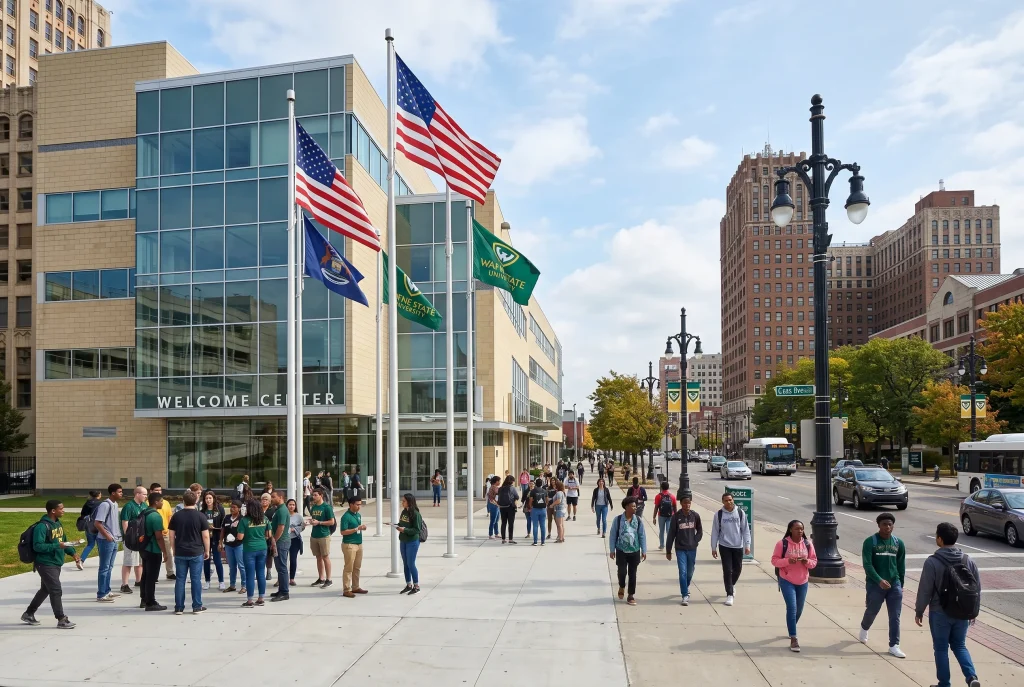
If you are wondering where the university is located, the short answer is Midtown Detroit, Michigan. The longer answer is that the campus is woven into the area around Woodward Avenue, near the Cultural Center, the Detroit Medical Center and a growing mix of restaurants, offices and apartments. Anyone who likes museums will be happy here. Our guide to museums in Detroit covers several that sit within a short walk or ride of campus.
The Wayne State campus in Midtown Detroit has an academic core with libraries, a Student Center and the Mort Harris Recreation and Fitness Center. Housing describes its apartments as less than a five-minute walk from classes and a 24-hour computer lab, which is a real quality-of-life detail if you have an 8 a.m. exam.
The upside is obvious. Internships, networking and culture are close at hand, and the QLINE and other transit options make it easier to get around without a car.
Now the practical side. This is an urban campus, not a green quad surrounded by cornfields. Commuting, parking and personal planning take more thought than at a small residential college. Some students love that. Others find it tiring by week six. Visit on a normal weekday, not just on tour day, and see how you feel about the pace.
Wayne State University Tuition, Fees, and Cost of Attendance
Here is the honest answer to “how much does Wayne State cost?” It depends. Wayne State University tuition is set by residency, academic level, course load, college or program, and fees, so a single sticker number would mislead more people than it helped. A Michigan resident in a general undergraduate program pays something very different from an out-of-state graduate student in a professional program.
That is why I would rather send you to the source. View Wayne State’s current tuition and fee charts and find the line that matches your situation.
Tuition is only part of the bill. Housing, meals, books, transportation, health insurance, and program-specific fees push the total up, sometimes by thousands of dollars a year. Build a full budget before you compare schools, not just a tuition number. Professional programs such as medicine, law, and pharmacy often carry their own rates and extra costs, so treat them as separate math.
For an outside check, the federal College Scorecard lets you compare costs, aid, graduation rates, debt and earnings across colleges. Between the official fee charts and that tool, you can build a realistic picture without relying on anyone’s marketing, including mine.
Wayne State University Admissions Requirements and How to Apply
Admissions starts with a choice of application. First-year students can apply through Wayne State’s own application or the Common App, and both are accepted. There is an application fee, and the amount is listed on the official page, so check it there before you pay.
The university has recently offered a test-optional path. Applicants who skip test scores generally complete short essay questions and submit a list of activities, and Common App materials may help meet that requirement. Transcripts are required either way. Letters of recommendation have been optional.
Is Wayne State University Hard to Get Into?
It depends on what you are applying to. For general undergraduate admission, there is no single published cutoff, and a recent incoming class profile put the average high school GPA around 3.4. That is an average, not a minimum. The reported undergraduate acceptance rate is 81.2 percent, so most applicants are admitted, but that blended number says nothing about the selective programs. Honors, nursing, pharmacy and others can set higher bars.
Professional schools are a different story. The medical school’s most recent class profile shows 10,438 applications for 299 seats, which tells you everything about how competitive that route is. Whatever your target, avoid assuming anything from a single number.
What GPA Do You Need?
Think of the average GPA as a signal and not a gate. A stronger transcript opens more scholarship doors, and your intended major can change the math. Ask the department directly if you are borderline.
Transfer, International, and Graduate Applicants
Transfer, international, graduate, and professional applicants follow different routes with different requirements. International students should review international application deadlines and requirements, because dates and English proficiency rules vary by country. Everyone else can see first-year application requirements and deadlines or start at the main undergraduate admissions hub. The academic calendar is also worth bookmarking for term dates.
Wayne State University Scholarships and Financial Aid
Money questions deserve straight answers. Scholarships include merit awards for first-year students, and the university lists named awards, along with athletic and program-specific scholarships. Examples from its first-year list include:
- Warrior Award
- Gold Award
- Detroit Leadership Award
- Green Award
- Scholar Award
- Anthony Wayne Award
Merit decisions are based on high school GPA and optional ACT or SAT scores, and applicants who apply test-optional are still considered. Submitting scores after admission may qualify you for a higher award without lowering one you already have.
Almost everything starts with the FAFSA, so file it early. The university has also said it provides hundreds of millions of dollars in aid each year across all levels.
One program worth knowing about is the Wayne State Guarantee. For eligible Michigan students, it combines federal, state and university aid to cover tuition and fees, and first-year students are considered automatically after admission and a completed FAFSA. At the time of writing, eligibility has been tied to Pell Grant status or family income and asset limits for Michigan residents, so read the current rules before you count on it.
Awards, priority deadlines, eligibility and renewal rules can all change from one year to the next. Scholarship money, for example, has generally been tied to fall and winter terms. Check current scholarships and financial-aid deadlines on the official site, then open the first-year scholarships page and the Wayne State Guarantee page for specifics. If you are a graduate or professional student, ask your department about assistantships and program-level funding too.
Wayne State University Student Life, Housing, and Athletics
Student life here looks different from what you would find at a campus with a football tradition and a town built around it. It is more self-directed. There is a wide range of student organizations, cultural groups and career-focused clubs, and many people join one or two and build a circle from there. Because this is an urban campus, many students commute or work while studying, which gives it a grown-up feel that some prefer.
Housing is where plans can go wrong if you wait. Residence halls and campus apartments cover students who want to live close, with rates and availability changing by term. Explore residence halls and on-campus apartments early, and ask about roommate matching and move-in dates. Many students live off campus in Midtown and nearby neighborhoods, which is its own research project.
Sports are part of the picture too, and they get their own section below.
For clubs, events and services, the student resources page is a good place to start.
Wayne State Warriors: Sports Teams and Athletics
Yes, Wayne State has a real athletics program, and it has more history than most people expect. The teams are the Warriors, they compete in NCAA Division II, and their home conference is the Great Lakes Intercollegiate Athletic Conference (GLIAC). The university counts 18 varsity sports today, and women’s soccer is set to become the 19th when it begins play in the 2026-27 academic year.
Established men’s teams include:
- Baseball
- Basketball
- Cross country
- Fencing
- Football
- Golf
- Swimming and diving
- Tennis
Established women’s teams include:
- Basketball
- Cross country
- Fencing
- Golf
- Softball
- Swimming and diving
- Tennis
- Track and field
- Volleyball
The full roster, with schedules and coaches, is on the official athletics site.
Recent Warriors News From 2025 and 2026
A few storylines from the last year give a better feel for where the program stands:
- Women’s soccer is coming. In July 2025 the university announced a new women’s varsity soccer team, the 19th varsity sport. It is scheduled to begin competition in the 2026-27 academic year, with a home field next to Tom Adams Field.
- Volleyball won its first GLIAC Tournament title. In November 2025 the Warriors beat top-seeded Ferris State 3-1 in the final, finishing 24-5 and earning an NCAA Tournament berth, their first since 2021. Senior Kayla Giroux was named tournament MVP.
- Women’s basketball had a strong March. The team reached the 2026 GLIAC semifinals, drew an NCAA Tournament matchup with Northern Michigan, and Gabi Lutchka was named first team All-GLIAC.
- Baseball had a story worth telling. Pitcher Will Lowery, a community college transfer, threw a no-hitter this spring, which Wayne State featured in an April 2026 profile.
- The classroom numbers set a record. A school-record 161 Wayne State student-athletes earned the D2 Athletics Directors Association Academic Achievement Award in August 2026, topping the previous high of 152. The award requires a cumulative GPA of at least 3.5.
Where the Warriors Play
Football plays at Tom Adams Field in Midtown, a turf stadium that opened in 1968 and holds a little over 6,000 fans. Basketball plays at the Wayne State Fieldhouse, and baseball has its own home at Harwell Baseball Field. Because it all sits on or near campus, a game is an easy evening add-on for students already in the neighborhood.
A Few Highlights Worth Knowing
- Fencing is the program’s historic standout. The men’s team has won seven national titles and the women’s team three, according to the program’s records.
- Football reached the Division II national championship game in 2011, losing to Pittsburg State.
- Women’s swimming won a national title in 2012.
- The nickname changed in 1999. The teams were once the Tartars, and the school switched to Warriors.
- Some alumni went pro. Running back Joique Bell, a Harlon Hill Trophy winner in 2009, later played for the Detroit Lions, and fencers Byron Krieger and Allan Kwartler competed in the Olympics.
It is not the Big Ten, and nobody pretends it is. But a Division II program in the middle of Detroit gives campus a shared place to gather, and the football season runs from early September into November. For game results and team news, check the official Warriors athletics site, and keep an eye on our Detroit sports coverage for future Wayne State stories.
Safety and Practical Considerations
Is Wayne State University safe? Fair assessments start with context. It is an urban university, and no campus in a major city can honestly be called perfectly safe or especially dangerous. A blanket label is not much use to you either way.
What you can do is look at facts. Read the annual security report, learn about emergency alerts and campus transportation, and see what services the university offers. Review current campus safety services and annual security information from Wayne State Police, then visit in person and ask current students how they get around after dark. Practical habits matter too: know your transit options, keep your belongings secure, and plan late-night trips ahead of time.
Careers, Internships, and Outcomes
A degree is only useful if it leads somewhere, so look at the career side early. The university’s Career Services office handles advising, internships and recruiting events. Detroit’s mix of health systems, automakers, financial firms and public agencies gives students plenty of places to try out a field before graduating.
The alumni numbers support this. With about 313,000 living alumni worldwide (a figure the Alumni Association updated in June 2026) and the university reporting that nearly three quarters of graduates stay in Michigan, the network is concentrated in this region. That can be a strength if you plan to stay in Michigan, and something to weigh if you hope to build a career elsewhere.
Earnings and debt also vary by program. Use the College Scorecard and your department’s career outcomes page to compare, and ask hard questions about job placement rates for the exact major you want.
How Wayne State Compares With Other Universities in Detroit
Wayne State is the largest of the universities in Detroit, but it is not the only choice. Here is how the main alternatives differ:
- University of Detroit Mercy: a smaller private Jesuit and Mercy institution known for its professional programs
- College for Creative Studies: focused on art and design
- University of Michigan-Dearborn: just outside the city, with a strong engineering and business focus
- Lawrence Technological University: in Southfield, leaning toward engineering, architecture and applied fields
The difference comes down to scale and mission. Wayne State offers more majors, more research and more public-university pricing for Michigan residents, while the smaller schools offer a tighter community and narrower specialties. If you are weighing several options, our full guide to universities in Detroit puts them side by side.
Who Should Choose Wayne State University?
Wayne State fits students who want a research university with real professional programs, who like the idea of interning in Detroit while still in school, and who value public-university pricing as Michigan residents. It also suits people who learn best in a city environment and do not need a traditional campus bubble.
So, is Wayne State a good school? For the right student, yes. For someone who wants a quiet, secluded campus, a small residential college or a school where almost everyone lives on site, probably not. Some students want exactly that, and that is fine.
Final Thoughts
Wayne State is best judged by what it offers for your specific goal, not by a ranking. Look at the exact program you want, the current cost for your residency, your aid eligibility, the deadlines and what graduates actually do afterward. If the answers line up, Wayne State could be an excellent fit. If they do not, you will know early, which is worth just as much.
Frequently Asked Questions
What is Wayne State University best known for?
Research, health sciences, engineering, law, business and its Midtown Detroit location. It is also recognized as an R1 research university, as noted in the university’s research classification announcement.
Is Wayne State University a good school?
It depends on fit. It works well for students who want broad academics, research access, internships and an urban setting. It is less ideal for those who want a small, secluded campus.
Where is Wayne State University located?
In Midtown Detroit, Michigan, close to the Cultural Center and the Detroit Medical Center.
How much does it cost to attend Wayne State University?
Costs vary by residency, level, program and course load. Check the official tuition charts and the financial aid office for current figures.
How many students attend Wayne State University?
The most recent official reporting shows 23,803 students, with 17,838 enrolled full-time and 5,965 part-time, across undergraduate, graduate and professional programs. Enrollment shifts each year, so check the official fast facts for the latest count.
Which majors does Wayne State University offer?
The university reports more than 370 programs across 13 schools and colleges. The program directory lists them all.
Is Wayne State University hard to get into?
The reported undergraduate acceptance rate is 81.2 percent, and a recent class averaged around a 3.4 high school GPA. Medicine, law, pharmacy and honors programs are far more competitive.
How do I apply to Wayne State University?
First-year students can use the Wayne State application or the Common App through the first-year application page. Transfer, international, graduate and professional applicants should use their own admissions routes.
Does Wayne State University offer scholarships?
Yes. See the first-year scholarships page, the financial aid office and the Wayne State Guarantee.
Does Wayne State University have student housing?
Yes, including residence halls and apartments. Rates and availability are on the Housing and Residential Life site.
Does Wayne State University have sports teams?
Yes. The Warriors compete in NCAA Division II in the GLIAC and field 18 varsity sports, with women’s soccer becoming the 19th in 2026-27. Teams include football, basketball, baseball, softball, volleyball, swimming and fencing. Schedules and results are on the official athletics site.
Is Wayne State University safe?
Treat it like any urban campus. Review the resources from Wayne State Police and judge it in person.
Does Wayne State University offer online degrees?
Yes, though it varies by degree. Use the program directory and filter by delivery method.
Leave a Reply