

Detroit is home to seven very different universities, from a 158-year-old research university that trains Michigan’s doctors and engineers to a once-closed HBCU that just became the first shuttered Black college in U.S. history to reopen. This guide breaks down what sets each of these universities in Detroit apart: cost, campus, history, and the one thing each does better than almost anyone else.
What Makes Detroit’s Universities Some of Michigan’s Most Diverse Campuses
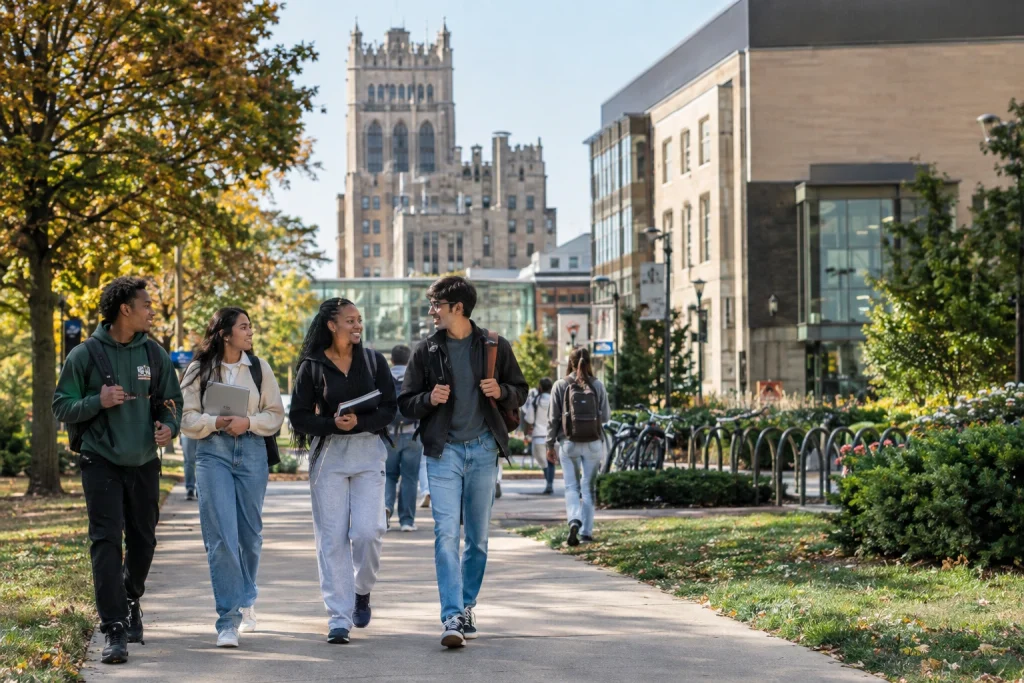
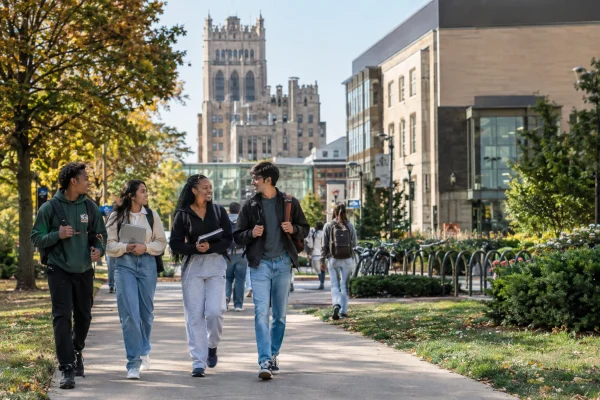
Walk onto any campus in Detroit and you’ll notice something quickly: these schools don’t look like a typical Michigan college. Detroit grew through waves of immigration tied to the auto industry and remains a majority-Black city with deep Middle Eastern and Latino communities, a history that shows up directly in local classrooms.
Wayne State University is the clearest example, with roughly 40% of its students identifying as students of color and undergraduates arriving from five continents. Pensole Lewis College of Business and Design takes that further: it’s Michigan’s only historically Black college, covered below.
That diversity extends to geography, too. Wayne State and College for Creative Studies both sit inside or beside Detroit’s Cultural Center Historic District, close enough to the Detroit Institute of Arts that students can walk there in about ten minutes.
Wayne State University: Detroit’s Research and Innovation Powerhouse
Wayne State University traces back to 1868, when the Detroit Medical College opened on Woodward Avenue. It took its current name in 1956 and now sits on roughly 200 urban acres in Midtown Detroit.
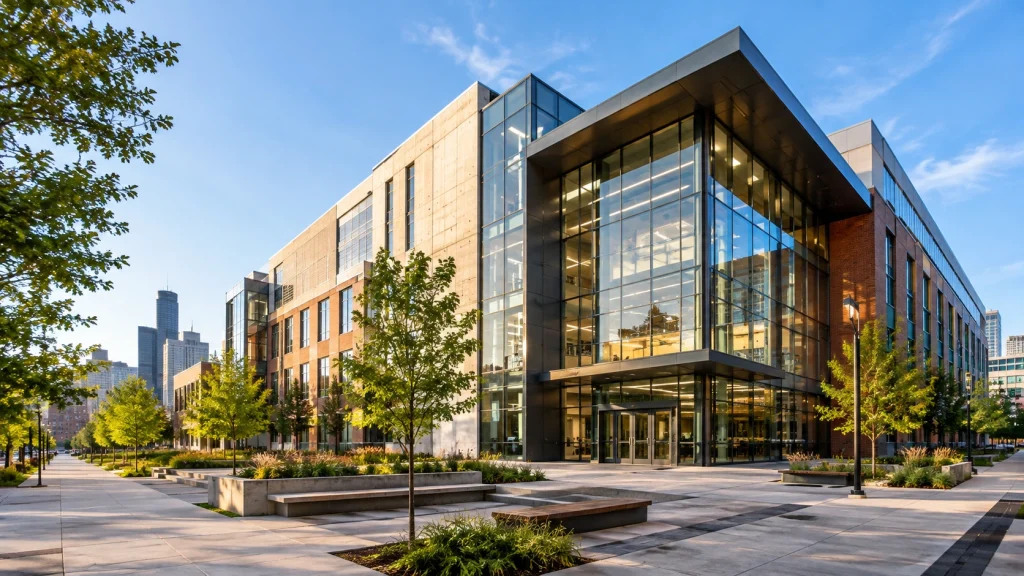
It’s one of only three Michigan schools carrying the Carnegie Foundation’s top research classification, alongside the University of Michigan and Michigan State University. The three built the University Research Corridor in 2006, rebranded in 2025 as Research Universities for Michigan with Michigan Tech added as a fourth partner.
Total enrollment runs around 24,000 students. In-state tuition and fees land near $16,000 to $17,000, out-of-state closer to $34,000 to $36,000, with strong pipelines through medicine, law, and engineering.
Good for: students who want a major research university with strong medical, law, and engineering programs at a lower price tag than most peers.
University of Detroit Mercy: A Legacy of Jesuit and Mercy Education
University of Detroit Mercy formed in 1990, when the Jesuit-founded University of Detroit (1877) merged with Mercy College of Detroit, founded by the Sisters of Mercy in 1941, the only Jesuit-and-Mercy institution in the country.
The main McNichols Campus sits on Detroit’s northwest side. A downtown campus houses the law school, founded in 1912 and ABA-accredited since 1933; the dental school, established in 1932, is one of only two in Michigan.
Total enrollment runs roughly 5,500 students, with tuition and fees around $33,000 to $35,000 before aid, and most first-year students receive need-based support.
Good for: students set on a Catholic, Jesuit-and-Mercy education who want a direct path into law, dentistry, or nursing without leaving Detroit.
College for Creative Studies: Where Art and Design Meet Detroit’s Creative Renaissance
College for Creative Studies started in 1906 as the Detroit Society of Arts and Crafts. Its defining moment came in 1933, when it became one of the first art schools in the country to formally declare automobile design a legitimate art form, a claim that still describes its most famous program today.
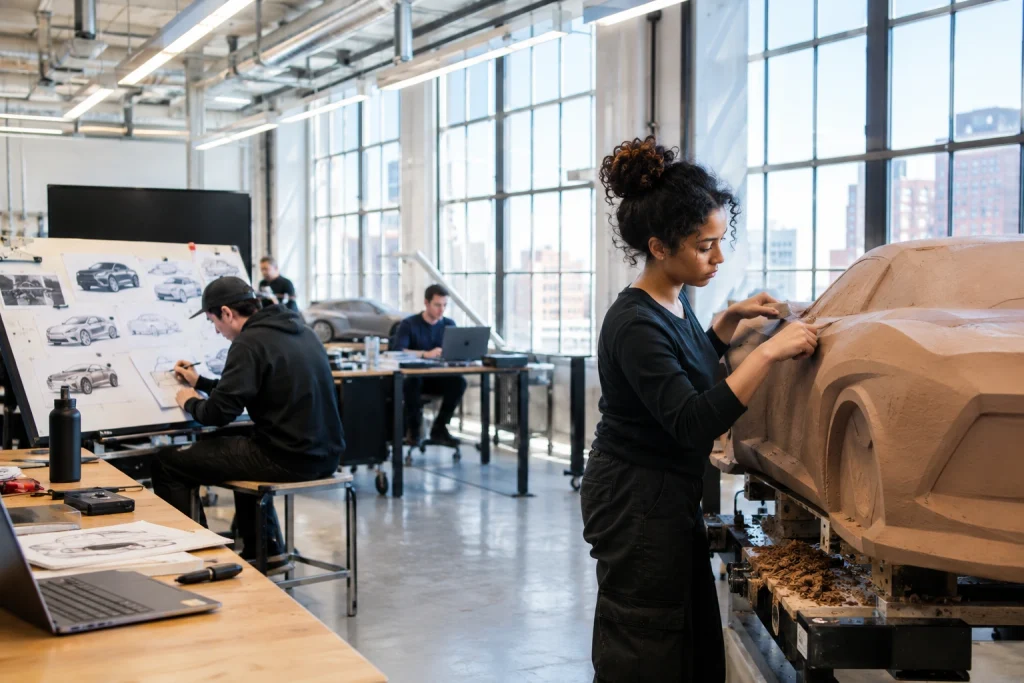
Its transportation design program is widely credited with placing more graduates into automotive design roles than any other school in the world, per the Detroit Historical Society.
Enrollment runs roughly 1,400 students, with tuition alone around $52,000 to $56,000 for 2025-26. The campus sits inside the Cultural Center, steps from the DIA.
Good for: students chasing a specific creative career, automotive design above all, with a century-long pipeline into Detroit’s design industry.
Pensole Lewis College of Business and Design: Reviving a Historic HBCU Legacy
Few schools have a story like this one. It began in 1928 in Indianapolis as the Lewis College of Business, founded by Dr. Violet T. Lewis with a $50 loan to train Black women as secretaries, at a time when many state schools denied them admission. It relocated to Detroit in 1939 and became, per Michigan Public and CBS News Detroit, a critical economic engine for the city’s Black community, with General Motors, Ford, and Michigan Bell reportedly hiring their first Black office employees from its graduates.
In 1987, the school earned HBCU designation, Michigan’s only one, before closing in the mid-2010s over lost accreditation. That changed in 2021, when former Nike design director D’Wayne Edwards became controlling stakeholder and relaunched it as Pensole Lewis College of Business and Design, adding a design focus to the original mission. It’s now the first previously closed HBCU in U.S. history to reopen, operating out of CCS’s Taubman Center with roughly 300 students while it works toward a permanent campus.
Good for: students who want to be part of an HBCU’s second act, built around corporate partnerships rather than a traditional tuition model.
Sacred Heart Major Seminary: Detroit’s Center for Catholic Theological Education
Sacred Heart Major Seminary is a different kind of school than anything else here. Bishop Michael Gallagher established it in 1919 to form Catholic priests, deacons, and lay ministers for the Archdiocese of Detroit, and its Gothic Revival building has been on the National Register of Historic Places since 1982.
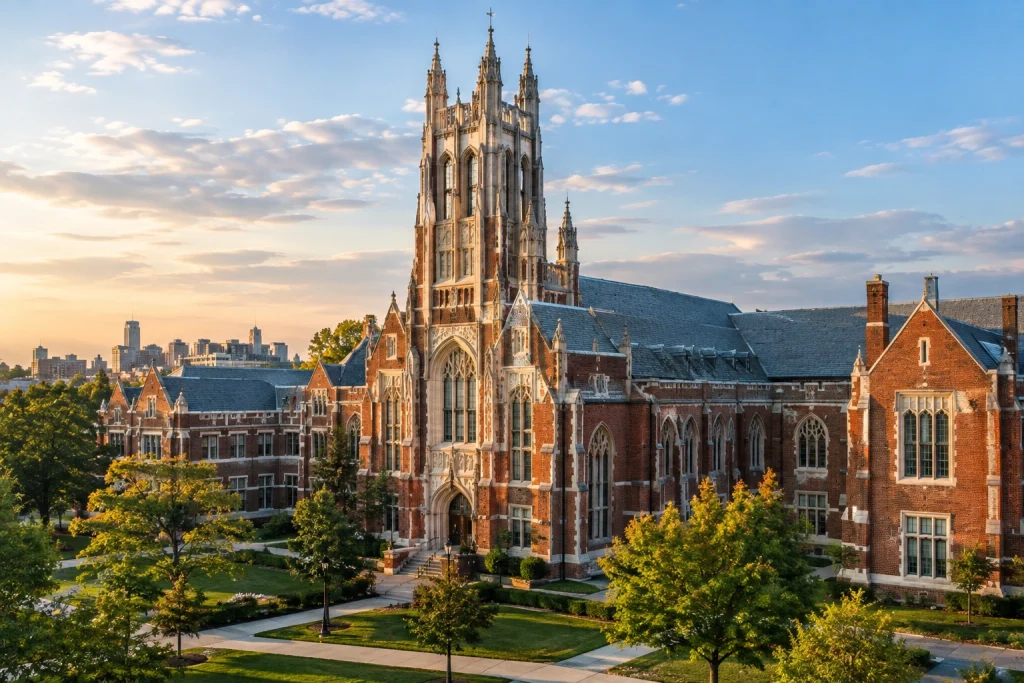
The seminary offers degrees from an Associate of Arts in Ministry up to a Master of Divinity, with theology programs accredited since 1991. Enrollment fluctuates between roughly 300 and 360 students, mixing seminarians with lay ministry students.
Good for: students discerning a vocation to the priesthood, diaconate, or lay ministry, not a general undergraduate search.
University of Michigan-Dearborn: A Big Ten Name with a Local Focus
A quick clarification: University of Michigan-Dearborn sits in Dearborn, just west of Detroit, not inside city limits, though it shares its name and governance directly with the Ann Arbor campus, whose Board of Regents still oversees it.
One nuance worth knowing: the “Big Ten” name refers to the University of Michigan brand and Ann Arbor’s conference membership, not Dearborn’s own teams, which compete in the NAIA.
Total enrollment runs around 8,200 students, with in-state tuition roughly $12,500 to $15,000 a year, well below Ann Arbor’s rate. Engineering, business, and computer science are the strongest majors, with recent graduates reporting starting salaries above $99,000.
Good for: budget-conscious students who want a University of Michigan degree on a smaller, commuter-friendly campus.
Lawrence Technological University: Michigan’s Hub for Engineering and Applied Sciences
Like UM-Dearborn, Lawrence Technological University sits just outside Detroit, in Southfield. Russell E. Lawrence founded it in 1932 as the Lawrence Institute of Technology, moved it to Southfield in 1955, and the school took its current name in 1989.
The university spans four colleges: Architecture and Design, Arts and Sciences, Business and IT, and Engineering. Its grounds even include the Frank Lloyd Wright-designed Affleck House, relocated to nearby Bloomfield Hills.
Enrollment runs roughly 3,000 to 4,500 students, with 2025-26 tuition around $42,000 to $46,000. Recent U.S. News rankings placed LTU at #49 among Regional Universities Midwest, with ABET- and NASAD-accredited engineering and architecture programs.
Good for: students focused on engineering, architecture, or applied sciences who want small class sizes in a suburban setting.
Choosing the Right University in Detroit: What Sets Each Institution Apart
Laid side by side, these seven schools split by mission, not prestige tier.
| Institution (Founded) | Type | Location | Enrollment | Tuition | Average Starting Salaries |
| Wayne State University (1868) | Public research | Detroit | ~24,000 | $16K–$35K | $52,000 |
| University of Detroit Mercy (1877/1990) | Catholic | Detroit | ~5,500 | ~$33K–$35K | $60,000 |
| College for Creative Studies (1906) | Art & design | Detroit | ~1,400 | ~$52K–$56K | $36,900 – $52,000 |
| Pensole Lewis College (1928/2021) | HBCU | Detroit | ~300 | Corporate-partner | $65,000 |
| Sacred Heart Major Seminary (1919) | Catholic seminary | Detroit | ~300–360 | Diocesan-supported | $49,295 – $63,721 |
| University of Michigan-Dearborn (1959) | Public (UM system) | Dearborn | ~8,200 | ~$12K–$15K | $53,000 – $62,000 |
| Lawrence Technological University (1932) | Private technical | Southfield | ~3,000–4,500 | ~$42K–$46K | $61,600 – $65,000 |
Wayne State is the obvious start for research and affordability. CCS and Lawrence Tech offer sharper pipelines for a specific creative or technical career. Sacred Heart and Pensole Lewis offer something no other school here can: faith formation, and an HBCU’s second chapter.
What this means for you: there’s no single “best” university in Detroit. Match the mission (research, licensure, portfolio-building, or a historic rebuild) to your own goal before you match a ranking number.
See also: Detroit Weekly News‘ guide to the Detroit Institute of Arts and Midtown’s museum row, since two schools here sit within walking distance of it.
Frequently Asked Questions on Universities in Detroit
How many universities does Detroit have?
Detroit hosts several four-year institutions directly within city limits: Wayne State University, University of Detroit Mercy, College for Creative Studies, Pensole Lewis College of Business and Design, and Sacred Heart Major Seminary. Widen the count to the greater metro area, including Dearborn and Southfield, and regional sources put the total closer to 30 colleges and universities.
What’s the best university in Detroit?
Wayne State University is generally the answer for overall reputation. It’s one of only three Michigan schools with the Carnegie Foundation’s top research classification and a founding member of the alliance now known as Research Universities for Michigan.
Which are Michigan’s top 5 universities?
Rankings shift by methodology, but the University of Michigan-Ann Arbor, Michigan State University, Wayne State University, Michigan Technological University, and University of Michigan-Dearborn consistently appear near the top of most Michigan-focused lists.
Is there a university in Detroit?
Yes. Detroit is home to multiple accredited, degree-granting institutions, from a major public research university (Wayne State) to specialized private colleges like College for Creative Studies, University of Detroit Mercy, and the reopened Pensole Lewis College.
What’s the biggest university in Detroit?
Wayne State University, with roughly 24,000 total students, is Detroit’s largest institution by enrollment, several times larger than any other school based directly within city limits.
What are the 3 largest universities in Michigan?
Michigan State University, the University of Michigan-Ann Arbor, and Wayne State University are consistently Michigan’s three largest institutions by total enrollment.
What’s the top college in Detroit?
It depends on the goal. Wayne State suits students prioritizing research and affordability, College for Creative Studies suits those chasing a design career, and University of Detroit Mercy suits students headed toward law, dentistry, or nursing.
What are the main colleges and universities in Detroit?
Within city limits, the major players are Wayne State University, University of Detroit Mercy, College for Creative Studies, Pensole Lewis College of Business and Design, and Sacred Heart Major Seminary. University of Michigan-Dearborn and Lawrence Technological University sit just outside city limits but are closely tied to Detroit’s education scene.
How does Detroit rank for education?
Detroit and Michigan overall have historically trailed the national average for adults holding a bachelor’s degree, a gap groups like Research Universities for Michigan cite as part of their rationale for expanding K-12 and higher-ed partnerships in the region. Even so, an R1 research university, several specialized professional schools, and a rebuilding HBCU give the city an unusually varied higher-education footprint for its size.
Is there a university near the DIA?
Yes. Wayne State University and College for Creative Studies both sit inside or immediately beside the DIA’s home turf, Detroit’s Cultural Center Historic District, roughly a ten-minute walk from the museum’s Woodward Avenue entrance.
Final Thoughts
Detroit’s higher-education landscape doesn’t fit into a single “best school” ranking. A research university, a Jesuit-and-Mercy professional school, a design college, a rebuilding HBCU, a Catholic seminary, and two engineering-focused suburban campuses are all doing different jobs for different students. Start with the outcome you want, confirm tuition and accreditation details with each school before applying, and the right university in Detroit becomes obvious fairly quickly.




Leave a Reply