
Table of Contents
You walk in through the Woodward Avenue entrance, and for a second, you forget you’re in Michigan. Marble everywhere. A ceiling that seems to keep going. Then someone’s kid sprints past toward the armor gallery, and you remember: this is still a working museum, not a mausoleum. That contrast is basically the whole appeal of the Detroit Institute of Arts.
The DIA sits at 5200 Woodward Avenue, right in Midtown’s Cultural Center, and it’s one of the largest, most encyclopedic art collections in the country, with somewhere north of 65,000 works, spread across more than 100 galleries. But raw numbers don’t tell you much. What matters more, if you’re actually planning a trip, is the practical stuff: when it’s open, what it costs, how long to budget, and what you’d be a fool to skip.
Hours, and the One Day You’ll Want to Avoid
The museum is closed Mondays. Full stop, no exceptions worth counting on. Beyond that, hours shift by day:
- Tuesday through Thursday: 9 a.m. to 4 p.m.
- Friday: 9 a.m. to 9 p.m.
- Saturday and Sunday: 10 a.m. to 5 p.m.
Friday nights are worth calling out specifically. The DIA stays open until 9, and that extended window tends to draw a different crowd: fewer field trips, more couples and after-work visitors. If you’ve ever tried to appreciate a Rembrandt while forty fifth-graders debate lunch plans nearby, you’ll understand why that matters.
Exhibition hours can run slightly different from general museum hours, especially during ticketed special shows, so it’s worth a quick check on the museum’s own site before you drive over.
Detroit Institute of Arts Is Actually Free? (Sort Of.)
This is where most third-party guides get lazy, and it’s worth untangling properly.
Standard admission runs $20 for adults, $10 for seniors and college students with valid ID, and $8 for youth ages 6 to 17. Kids five and under get in free, as do members.
But here’s the part that surprises people who don’t live in the area: residents of Wayne, Oakland, and Macomb counties get in free, no ticket purchase required. That’s not a coupon or a promotional gimmick; it’s the result of a 2012 tri-county millage, a small property tax increase that voters approved specifically to fund the museum in exchange for guaranteed free general admission for residents.
Bring an ID showing your address in one of those three counties, and you walk in without paying. It’s a genuinely unusual arrangement for a major U.S. art museum, and it’s the reason the DIA survived Detroit’s 2013 bankruptcy with its collection largely intact. The “Grand Bargain” that resolved the city’s debt crisis specifically protected DIA artwork from being sold off, partly because of the public investment the millage represented.
If you’re not a tri-county resident, you’re paying the standard rate. Either way, confirm current pricing before you go, since museum ticket prices do get adjusted over time.
How Long You Should Actually Plan For
People consistently underestimate this. I’ve watched friends budget an hour for the DIA the same way they’d budget an hour for a mid-size regional museum, and then get frustrated when they’re rushed out the door having seen maybe a third of what they wanted.
Realistically, there are three tiers:
The highlights run (about 90 minutes). You head straight for Rivera Court, spend real time there, then hit two or three adjacent galleries on your way out. This works if you’re squeezing the DIA into a bigger day of Midtown sightseeing.
The half-day visit (around three hours). This is the sweet spot for most first-time visitors. Enough time for Rivera Court, the European paintings galleries, a browse through the African American art collection, and a coffee break at Kresge Court without feeling rushed.
The full-collection deep dive (five-plus hours). For people who genuinely love art or are working through a specific research interest. At this pace, plan to split it across two visits, because gallery fatigue is real and nobody absorbs anything meaningful after hour four.
What You Shouldn’t Skip
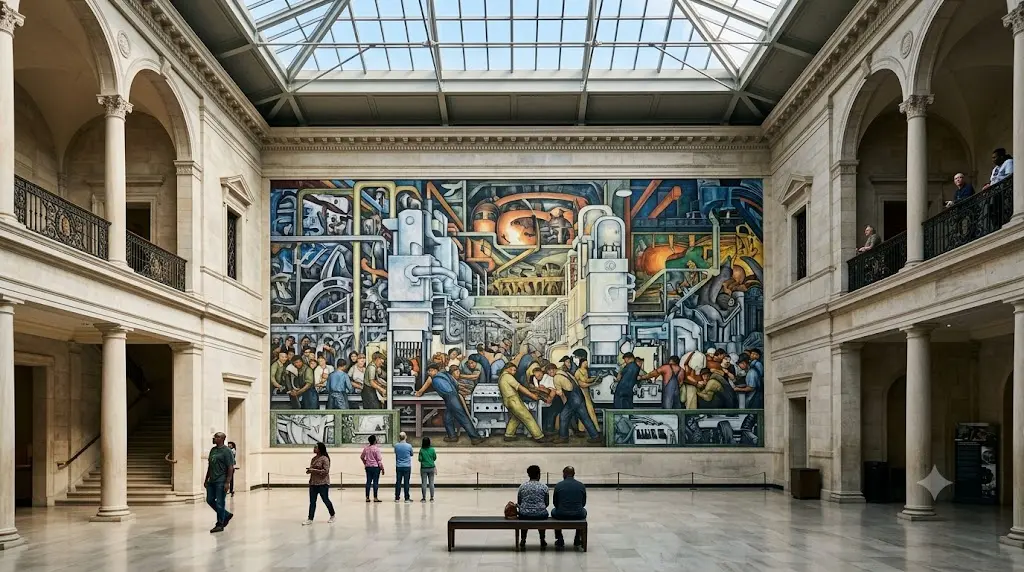
Everything eventually points back to one room: Rivera Court.
Between 1932 and 1933, Diego Rivera painted a 27-panel fresco cycle across the walls of what was then called the Garden Court, commissioned by Edsel Ford and the museum’s then-director, William Valentiner. The murals, known collectively as Detroit Industry, depict the Ford Motor Company’s River Rouge plant and the broader machinery of industrial labor not a flattering postcard version, either. Rivera included the harsher edges of manufacturing alongside its scale and ambition, which apparently didn’t sit well with everyone at the time.
The murals were nearly destroyed decades later, during a period when their political undertones made some patrons uncomfortable. They survived, and in 2014 the U.S. Department of the Interior designated them a National Historic Landmark.
Standing in that room does something a photo can’t replicate. The scale is the whole point: you’re not looking at a mural, you’re standing inside one.
For deeper context on how Rivera Court fits into Detroit’s wider art scene, and what else the city’s museum landscape looks like right now, detroitweeklynews.com’s museum roundup is a solid next stop.
Tours, If You Want Structure
The DIA runs docent-led tours on a regular schedule, generally covering either general highlights or specific thematic tracks depending on the day. If you’re the type who wants context rather than wandering solo, it’s worth checking what’s scheduled before you arrive tour availability and topics shift, and calling ahead beats showing up and hoping.
Group tours, for school trips or larger parties, need to be booked in advance separately from general admission.
Parking Isn’t Complicated, But It’s Worth Knowing Ahead of Time
There’s a museum-operated lot behind the building, off John R Street, running about $8 a day. Metered street parking exists too, but the City of Detroit caps it at two hours, which won’t cover a real visit unless you’re doing the fast highlights version. A couple of nearby structures, including one run by Wayne State University, fill the gap for longer stays.
None of this is difficult, but it’s the kind of detail that ruins an otherwise good afternoon if you find out about it after circling the block twice.
Is the DIA (Detroit Institute of Arts) free?
Only if you’re a resident of Wayne, Oakland, or Macomb County — bring an ID with your address, and you get in at no cost, thanks to the 2012 tri-county millage. Everyone else pays standard admission.
How much does it cost to visit?
$20 for adults, $10 for seniors and college students with ID, $8 for youth ages 6–17. Kids five and under, and museum members, get in free.
What are the DIA’s hours?
Closed Monday. Tuesday through Thursday, 9 a.m. to 4 p.m.; Friday, 9 a.m. to 9 p.m.; Saturday and Sunday, 10 a.m. to 5 p.m. Special exhibitions can run slightly different hours, so double-check before you go.
How long should I plan to spend there?
Ninety minutes covers the highlights, including real time in Rivera Court. Three hours gets you a proper half-day visit. Serious collection deep-dives run five-plus hours, ideally split across two trips.
What’s the one thing I shouldn’t skip?
Rivera Court. The Diego Rivera murals are the museum’s centerpiece, and no photo does the scale justice.
Where do I park?
The museum’s own lot behind the building on John R Street runs about $8 a day. Street parking is metered and capped at two hours, so it only works for a fast visit. Nearby structures, including one operated by Wayne State University, cover longer stays.
The Honest Take
The DIA doesn’t need much marketing spin. It’s a genuinely major collection sitting in a city that, for a long stretch, didn’t get much credit for its cultural institutions. The free admission for tri-county residents is unusual and worth using if you qualify. The Rivera murals alone justify the trip for most visitors, and everything else the European paintings wing, the African American art galleries, the special exhibitions is a bonus layered on top of that.
If you’re building out a bigger day around it, Midtown’s cultural corridor has plenty else worth your time, and Detroit Weekly News’ arts and culture section tends to track what’s currently worth seeing beyond the DIA itself. For ongoing coverage of Detroit’s broader art and culture calendar, Detroit Weekly News is worth bookmarking before your trip.
Go on a Friday evening if you can swing it. Fewer school groups, better light through the courtyard skylights, and you get an extra five hours on the clock compared to a weekday morning visit.
Leave a Reply