
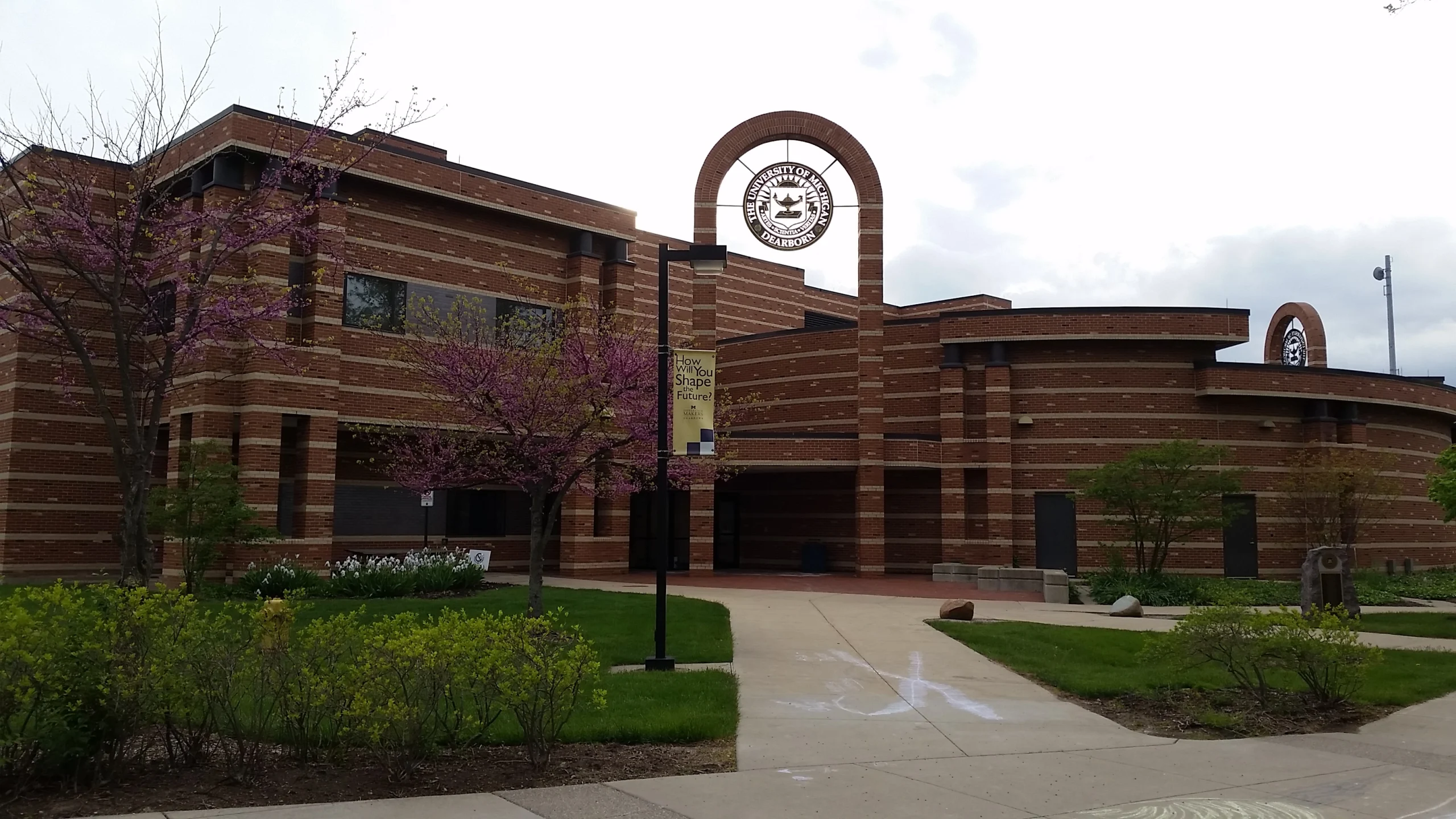
A quick clarification up front, because this comes up constantly: University of Michigan Dearborn sits in Dearborn, not inside Detroit’s city limits, and it is not the Ann Arbor campus most people picture when they hear “University of Michigan.” It’s a separate campus within the University of Michigan system, with its own chancellor, its own admissions process, and its own academic identity, even as it shares the university’s name, its Board of Regents, and its Maize and Blue colors.
That distinction matters because UM-Dearborn has built a genuinely different experience from its larger sibling: roughly 7,700 to 8,000 students, four colleges built around career-focused fields like engineering and business, and a tuition bill that runs well below Ann Arbor’s, backed by an aid program that covers full tuition for a majority of its in-state freshmen. Here’s what makes it distinct from other Detroit-area universities, what it costs, and who it fits.
Table of Contents
What Makes UM-Dearborn Different?
UM-Dearborn runs as a mid-sized, largely commuter-friendly campus with four academic colleges and a strong regional workforce pipeline into Southeast Michigan employers. Unlike Ann Arbor’s sprawling research-university scale, Dearborn keeps an average class size of 27 students and a 1:16 faculty-to-student ratio, with 62% of all classes enrolling fewer than 30 students, according to the university’s facts and figures page.
It carries the University of Michigan name and governance, and shares the university’s Board of Regents, but it is not a smaller version of Ann Arbor. Admissions, academic programs, student life, and athletics all operate independently at the Dearborn campus level.
History and Relationship to the University of Michigan
UM-Dearborn was founded in 1959 on land donated by Ford Motor Company (see the campus facts and figures), near Henry Ford’s own Fair Lane estate, and it remains one of three campuses governed under the University of Michigan’s Board of Regents, alongside Ann Arbor and Flint. That shared governance is real: degrees carry the University of Michigan name, and doctoral programs run under the authority of the university’s Rackham Graduate School. But day-to-day operations, admissions, and campus culture are distinctly Dearborn’s own, led as of 2026 by Chancellor Gabriella Scarlatta.
Academics and Popular Programs
UM-Dearborn organizes its more than 100 undergraduate programs across four colleges, plus 70 minors and 68 graduate degrees and certificates.
Engineering and Computer Science
The College of Engineering and Computer Science anchors much of UM-Dearborn’s reputation, with signature programs in mechanical, electrical, industrial and manufacturing systems, bioengineering, robotics, cybersecurity, data science, and software engineering. Students here have competed in national initiatives like the Battery Workforce Challenge electric-vehicle competition and NASA-linked autonomous drone research, a natural fit given the campus’s roots in Ford-donated land and its location near the heart of the American auto industry.
Business
The College of Business carries AACSB accreditation and has drawn recognition from U.S. News, Poets&Quants, and The Princeton Review. Majors include accounting, finance, supply chain management, information systems management, marketing, and human resource management, supported by an on-campus Bloomberg Finance Lab.
Arts, Sciences, and Letters
The College of Arts, Sciences, and Letters houses UM-Dearborn’s psychology, biological and physical sciences, criminology, communications, actuarial mathematics, and humanities programs, along with the campus Honors Program.
Education, Health, and Human Services
The College of Education, Health, and Human Services covers education, health and human services, public health, and a popular sports management major. It recently launched five new online teacher-training partnerships, letting community college graduates across Northern Michigan, the Upper Peninsula, and other regions complete UM-Dearborn teaching degrees without relocating.
Graduate and Doctoral Offerings
Beyond its 68 graduate degrees and certificates, UM-Dearborn offers seven doctoral programs sanctioned through the University of Michigan’s Rackham Graduate School, reflecting the campus’s 2025 reclassification as a Carnegie R2 research institution after generating more than $12.4 million in sponsored research awards that year.
What this means for you: if you’re drawn to UM-Dearborn specifically for engineering, business, or computer science, know that those programs carry the same accreditation standards and University of Michigan degree name as Ann Arbor’s, just delivered through a smaller campus with considerably more direct faculty access.
Campus, Location, and Student Life
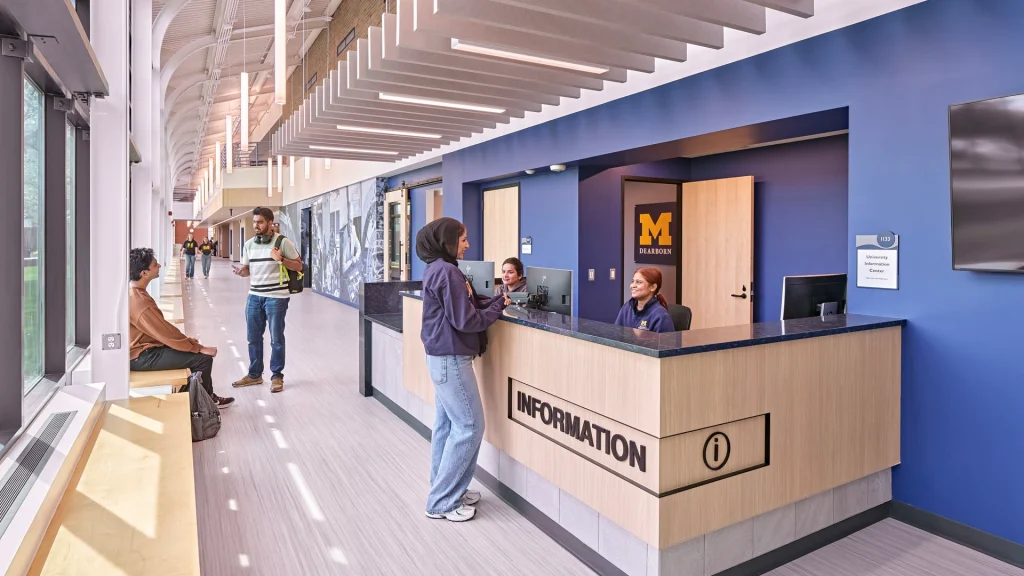
The Dearborn campus sits at 4901 Evergreen Road on land donated by Ford Motor Company, adjacent to Detroit but outside city limits. A recent renovation, covered in the 2026 State of the University report, consolidated admissions, orientation, advising, One-Stop Student Services, counseling, career services, and student organizations into a single hub inside the James C. Renick University Center, and a separate renovation of the College of Education, Health, and Human Services building wrapped up in 2026.
UM-Dearborn also maintains dedicated transfer-advising offices at Henry Ford College, Macomb Community College, and Schoolcraft College, along with articulation agreements with several other Michigan community colleges, a structure that helped drive an 18% jump in new transfer students for fall 2026.
Tuition, Financial Aid, and Cost
For 2026-27, upper-division in-state tuition and fees run from $17,608 in Arts, Sciences and Letters and Education, Health and Human Services, up to $19,864 in Engineering and Computer Science, and $20,464 in Business. Out-of-state rates run roughly double, and the university’s cost of attendance overview breaks down estimates by residency and living arrangement.
| College (2026–27, Upper-Division) | In-State Tuition + Fees | Out-of-State Tuition + Fees |
| Arts, Sciences & Letters / Education, Health & Human Services | $17,608 | $36,232 |
| Engineering & Computer Science | $19,864 | $38,512 |
| Business | $20,464 | $39,112 |
Those sticker numbers tell only part of the story, and the full cost of attendance estimates add housing, food, books, and transportation. Through the Go Blue Guarantee, the Michigan Achievement Scholarship, and institutional aid, 59% of full-time in-state first-year students pay $0 tuition, and 35% of all full-time in-state undergraduates have tuition and fees fully covered. The same guarantee extends further for out-of-state students near the Great Lakes region: undergraduates and online graduate students from states bordering the Great Lakes, and from Ontario, Canada, can qualify for in-state tuition rates through the Great Lakes Scholarship. Partly as a result, 59% of full-time in-state undergraduates graduate completely debt-free.
What this means for you: before ruling out UM-Dearborn on sticker price, check your eligibility for the Go Blue Guarantee and, if you’re coming from a bordering state or Ontario, the Great Lakes Scholarship. A majority of in-state freshmen end up paying nothing in tuition at all.
Admissions and How to Apply
UM-Dearborn runs separate application pathways for first-year, transfer, international, and graduate applicants, each with its own requirements and deadlines. The campus’s growing transfer partnerships with regional community colleges make it a particularly common next step for students starting at a two-year school in Southeast Michigan, and the fall 2026 incoming class included 608 new transfer students, the fifth straight year of transfer growth.
Athletics and the Big Ten Clarification
Here’s a genuinely common point of confusion: UM-Dearborn teams wear the same Maize and Blue as Ann Arbor and go by the Wolverines nickname, but they do not compete in the Big Ten, or in the NCAA at all. UM-Dearborn athletics compete in the NAIA, with eight of its nine varsity teams playing in the NAIA Division II Wolverine-Hoosier Athletic Conference and the men’s ice hockey team competing in the ACHA Division I Great Lakes Collegiate Hockey League. The university also fields seven club sports. The Big Ten name and conference membership belong to the Ann Arbor campus alone.
Who Should Choose UM-Dearborn?
Good for: students seeking a University of Michigan education in a smaller, more locally focused setting, especially in engineering, business, computer science, and other career-focused fields, who want substantial financial aid and don’t need a Big Ten sports atmosphere.
Students specifically chasing the Ann Arbor campus experience, Big Ten athletics, or a large residential research-university environment should look at UM’s flagship campus instead. See Detroit Weekly News’ guide to leading universities in Detroit for how UM-Dearborn compares to Wayne State, Lawrence Tech, and the city’s other institutions.
Frequently Asked Questions About University of Michigan Dearborn
Is University of Michigan Dearborn in Detroit?
No. UM-Dearborn sits in Dearborn, Michigan, adjacent to Detroit but outside the city’s limits, at 4901 Evergreen Road on land originally donated by Ford Motor Company.
Is UM-Dearborn part of the University of Michigan?
Yes. It’s one of three campuses, alongside Ann Arbor and Flint, governed by the University of Michigan’s Board of Regents, and its degrees carry the University of Michigan name. Day-to-day admissions, academics, and campus life operate independently from Ann Arbor, though.
Is UM-Dearborn a Big Ten school?
No. UM-Dearborn athletics compete in the NAIA, not the NCAA’s Big Ten conference. Big Ten membership belongs specifically to the University of Michigan’s Ann Arbor campus.
How much does UM-Dearborn cost?
For 2026-27, upper-division in-state tuition and fees range from $17,608 to $20,464 depending on college, with out-of-state rates roughly double. Through the Go Blue Guarantee and related aid, 59% of full-time in-state first-year students pay $0 tuition.
What majors is UM-Dearborn known for?
Engineering and computer science, business, and psychology draw some of the strongest enrollment and recognition, backed by an AACSB-accredited business college and engineering programs tied directly into Southeast Michigan’s automotive and manufacturing industries.
How many students attend UM-Dearborn?
UM-Dearborn reported roughly 8,005 total students for the 2025-26 academic year, and welcomed about 1,982 new students for fall 2026, bringing total fall 2026 enrollment to approximately 7,741.
Does UM-Dearborn offer housing?
UM-Dearborn primarily serves a commuter student population, though prospective students should check current on-campus housing options directly with the university, since availability and offerings can change from year to year.
How do I apply?
UM-Dearborn runs separate application pathways for first-year, transfer, international, and graduate applicants through its admissions site, each with its own requirements and deadlines.
Final Thoughts
University of Michigan Dearborn occupies a distinct space among Detroit-area universities: a University of Michigan campus in its own right, with a smaller scale, a stronger financial aid safety net for in-state students, and an entirely separate athletics identity from Ann Arbor’s Big Ten program. Students drawn to engineering, business, or computer science, and comfortable trading a large research-university atmosphere for smaller classes and direct faculty access, tend to find real value here, especially once the Go Blue Guarantee is factored in. Confirm current tuition, program-specific admissions requirements, and aid eligibility directly with the university before applying, since those figures shift year to year.
Sources consulted:
- University of Michigan Dearborn, Facts and Figures
- University of Michigan Dearborn, Academic Programs
- University of Michigan Dearborn, Undergraduate Applicants
- University of Michigan Dearborn, Tuition and Fees
- University of Michigan Dearborn, Cost of Attendance
- University of Michigan Dearborn, Undergraduate Cost of Attendance (2026–27)
- University of Michigan Dearborn, September 2026 enrollment release
- University of Michigan Dearborn, 2026 State of the University
- University of Michigan Dearborn, Athletics
Leave a Reply