

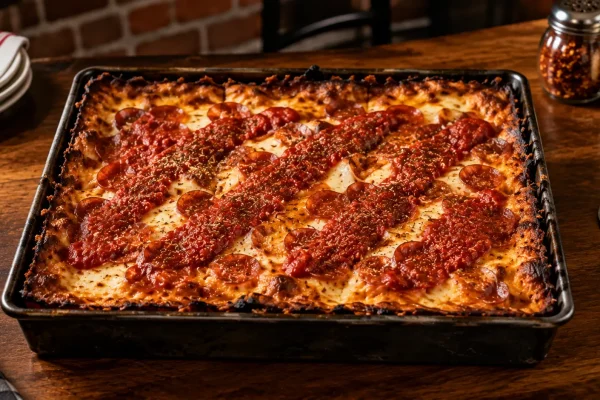
Detroit style pizza is a rectangular, deep-pan pizza from Detroit, Michigan, with an airy, chewy crust that’s crisp on the bottom, cheese baked to the pan’s edges until it caramelizes, and tomato sauce on top in stripes. It was first served at Buddy’s Rendezvous in 1946.
Detroit style pizza at a glance
- Shape: Rectangular, baked in a deep steel pan
- Crust: Thick and airy inside, crisp on the bottom and edges
- Cheese: Traditionally Wisconsin brick cheese, spread to the pan walls
- Sauce: On top of the cheese, usually in stripes
- Origin: Detroit, Michigan, 1946
What Does “Detroit Style” Pizza Mean?
The name describes a method as much as a place. Detroit style pizza is baked in a deep, heavy rectangular pan, with cheese pushed all the way to the edges and sauce added on top. Pizzerias well outside Michigan now make it, and they call it Detroit style for the same reason others say New York-style or Chicago deep dish: the name points to a recognizable set of traits.
In Detroit, people often just call it “a square,” even though the pans are rectangular. That’s local slang. If you’ve seen it written as “Detroit pizza” or “a Detroit pizza,” it’s the same thing.
What Is Detroit Style Pizza Like?
It’s a thick pizza that isn’t dense, and the texture is what surprises first-timers.
The crust
The inside is soft, airy, and chewy, closer to focaccia than to a thin New York slice. The bottom and sides pick up a crunch from the pan. The thick steel pans, more like a cast-iron skillet than a cake pan, are what produce the soft interior and crunchy exterior.
The caramelized cheese edge
This is the feature people recognize from photos. Cheese is spread edge to edge, so it melts outward until it meets the pan walls, then caramelizes against the steel into a lacy, crisp border. It’s often called frico, an Italian word for crisped cheese. The traditional cheese is Wisconsin brick cheese, a mild, buttery melting cheese. Corner pieces, which have two crisp edges, are usually the most sought-after slices.
The sauce on top
Sauce goes over the cheese rather than under it, often in stripes that fans nickname “racing stripes.” Some shops add it before baking and others after, so you’ll see slight variations from place to place.
The toppings
Pepperoni is the classic, and it’s often pressed into the dough beneath the cheese. Restraint matters. A Gordon Food Service executive chef warns that overloading the pizza keeps the center from cooking properly and leaves it doughy.
In short: rich, cheesy, crunchy at the edges, and bready without being heavy.
Who Invented Detroit Style Pizza, and Where Did It Originate?
Gus Guerra is credited with inventing it. He made his first square pizza in 1946 at Buddy’s Rendezvous, at Six Mile and Conant on Detroit’s east side.
Buddy’s Rendezvous and the Guerras
Buddy’s was a neighborhood bar, a former Prohibition-era speakeasy, whose owner wanted to add food. Guerra enlisted his wife, Anna, who borrowed a dough recipe from her Sicilian mother. The style descends from Sicilian pizza. Historical accounts credit the Sicilian-style base either to Anna’s mother’s sfincione recipe or to a Sicilian employee, Connie Piccinato.
The auto-industry pans
The pans are the part of the story that ties the pizza to its city. The pizza was baked in blue steel pans from local automotive suppliers, used in car factories as drip trays or to hold small parts. Buddy’s own history says the pans were forged steel, borrowed from local automotive plants. Exactly how they reached Guerra’s kitchen is partly legend. To see how a factory town shaped this kind of improvisation, read our overview of Detroit’s auto industry.
Buddy’s, Cloverleaf, and Loui’s
The story didn’t end at Buddy’s. Guerra sold it in 1953 and opened Cloverleaf in what is now Eastpointe, and former Buddy’s employee Louis Tourtois later founded Loui’s Pizza in Hazel Park. Because of that history, both Buddy’s and Cloverleaf claim to be the originators of the style. Buddy’s says its 1946 pizza was the first known square pizza in the U.S.
Detroit Style Pizza vs. Other Pizza Styles
| Style | Shape | Crust | Cheese and sauce | Main difference |
|---|---|---|---|---|
| Detroit style | Rectangular | Thick, airy, crisp bottom and edges | Cheese to the pan edge; sauce on top | Caramelized cheese border |
| Chicago deep dish | Round | Tall, pie-like | Cheese layered beneath a thick sauce | Heavier, more casserole-like |
| Sicilian | Rectangular | Thick, bread-like | Varies by recipe | Detroit adds edge-to-edge cheese and a steel pan |
| New York-style | Round | Thin, foldable | Sauce under the cheese | Much thinner, with larger slices |
| Roman (al taglio) | Rectangular | Airy, sheet-pan style | Sold by the slice; toppings vary | Sheet-pan street-food format |
Is Detroit style pizza the same as deep dish?
No. Both are baked in deep pans, but Detroit style is lighter, with a taller, airy crust and caramelized cheese edges. Chicago deep dish is heavier and pie-like, with cheese layered under a thick layer of sauce.
Is Detroit style pizza like Sicilian pizza?
It’s a relative. Detroit style was influenced by square Sicilian-style pizza. The differences are the cheese that runs to the pan’s edges, the crisp caramelized border, and sauce on top.
Why is Detroit style pizza square?
The shape comes from the pan. The rectangular steel pans define the slice, and they give nearly every piece crisp edges.
Why Is Detroit Style Pizza Trending in 2026?
Industry reporting backs up the trend. Pizza Today’s 2026 trends report says Detroit has broken into the Top 5 pizza styles in the U.S., and more than 45% of surveyed pizzeria operators were interested in adding a new style. Trade coverage of the report says Pizza Today named Detroit style the No. 1 pizza trend to watch in 2026, and that it rose to No. 4 in its ranking of America’s Top 10 Pizza Styles. Tasting Table reports it has overtaken Sicilian, deep dish, and even Neapolitan in popularity.
These rankings come from pizza-industry publications, so they reflect what the trade is seeing rather than a consumer poll.
There are a few likely reasons the style is catching on: the texture is distinctive, the cheese edge and sauce stripes photograph well, the pizza is easy to share, and it works as a base for new toppings. That last point is already happening. Trade coverage of the Pizza Today report points to hot honey and Calabrian chiles as rising ingredients, and suppliers are promoting Detroit style crusts topped with BBQ chicken. Those are modern twists, not the traditional pie.
Where to Try Detroit Style Pizza in Metro Detroit
Start with the origin story.
- Buddy’s Pizza: The restaurant that grew out of Buddy’s Rendezvous now has multiple locations across Michigan.
- Cloverleaf Pizza (Eastpointe): Opened by Guerra after he sold Buddy’s, and it says it carries on the original recipe he developed at Buddy’s.
- Loui’s Pizza (Hazel Park): Founded by a former Buddy’s employee.
- Other local names: Shield’s, Jet’s, and Luigi’s the Original in Harrison Township also serve the style.
Menus and hours change, so check each restaurant’s website before you go.
Detroit Style Pizza FAQs
What is Detroit style pizza?
Detroit style pizza is a rectangular, deep-pan pizza from Detroit, Michigan, with an airy, chewy crust that’s crisp on the bottom, cheese baked to the pan’s edges until it caramelizes, and tomato sauce on top in stripes. It was first served at Buddy’s Rendezvous in 1946.
Who invented Detroit style pizza?
Gus Guerra is credited with creating Detroit style pizza in 1946 at Buddy’s Rendezvous, the Guerras’ tavern on Detroit’s east side. Accounts differ on whether the Sicilian-style dough came from his wife Anna’s mother or from employee Connie Piccinato. After Guerra sold Buddy’s in 1953, he opened Cloverleaf in Eastpointe.
Where did Detroit style pizza originate?
It originated at Buddy’s Rendezvous, at Six Mile Road and Conant Street on Detroit’s east side, in 1946. Buddy’s calls it the first known square pizza in the U.S. The style was influenced by Sicilian pizza, and the original pans reportedly came from local automotive plants.
What does Detroit style pizza taste like?
Detroit style pizza tastes rich, cheesy, and slightly buttery, with a soft, airy interior and a crunchy, almost fried crust. The caramelized cheese edge adds a toasty, savory bite, while the tomato sauce on top adds tang. It’s substantial without being as heavy as Chicago deep dish.
Why is Detroit style pizza rectangular?
It’s rectangular because it’s baked in a deep rectangular steel pan. Buddy’s history says the first pizzas were baked in forged-steel pans borrowed from local automotive plants. The shape gives nearly every slice a crisp edge, and the corner pieces are especially popular.
What cheese is used on Detroit style pizza?
Wisconsin brick cheese is the traditional choice. It’s spread all the way to the pan’s edges so it melts against the hot steel and caramelizes into a crisp border. Not every pizzeria uses it, so ask if that matters to you.
What is the crispy cheese edge on Detroit style pizza called?
The crispy border is often called frico, an Italian word for cheese crisped by baking or frying. It forms when cheese spread to the pan’s edges melts against hot steel. It’s the style’s most recognizable feature, and many fans consider the corner pieces the best part.
Is Detroit style pizza deep dish?
Not exactly. Detroit style is pan-baked and deep, but it’s rectangular, with an airy crust, cheese that reaches the edges, and sauce on top. Chicago deep dish is round, heavier, and more pie-like, with cheese layered beneath a thick layer of sauce.



Leave a Reply