
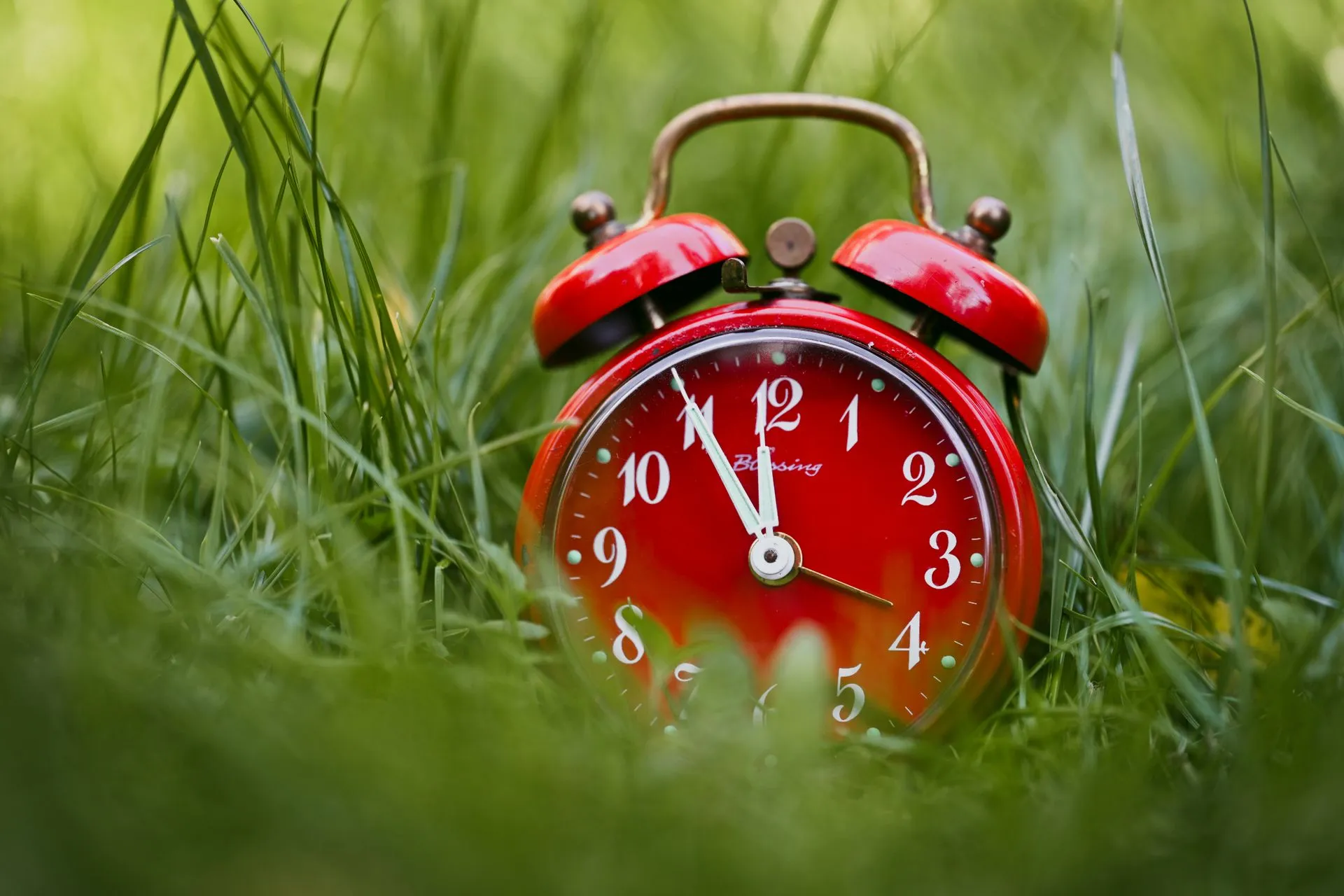
Twice a year, nearly every clock in the country jumps. One hour vanishes in March. One hour reappears in November. Most Americans grumble about it, half-remember which direction it goes, and move on with their day.
But daylight saving time is stranger and more contested than that annual shrug suggests. It started as a wartime fuel-saving measure, not a favor to farmers. It has survived more than a century of debate, repeal, and reinstatement. And a wave of research published in just the last year or two has reopened the question of whether the whole system still makes sense.
Last updated: November 1, 2026.
This guide walks through what daylight saving time actually is, where it came from, how the clock shift hits your sleep and health, and where the push to end it stands right now.
Table of Contents
What Is Daylight Saving Time?
Daylight saving time, or DST, is the practice of setting clocks one hour ahead of standard time for part of the year. The idea is simple: shift an hour of daylight from the early morning, when most people are still asleep, into the evening, when more people are awake and active.
Standard time is the baseline, set according to each time zone’s position relative to the sun. Daylight saving time is standard time plus one hour. So when clocks “spring forward” in March, 2 a.m. standard time becomes 3 a.m. daylight time. When they “fall back” in November, the clocks return to standard time, and that lost hour comes back.

It’s worth being precise about this because the common phrasing gets it backwards. DST doesn’t create more daylight. The sun rises and sets exactly when it always does. What changes is the number printed on the clock face at that moment.
When Does Daylight Saving Time Start and End?
In the United States, daylight saving time begins at 2 a.m. local time on the second Sunday in March and ends at 2 a.m. local time on the first Sunday in November. These dates are set by federal law, specifically the Energy Policy Act of 2005, and they apply uniformly across every state and territory that observes DST.
In 2026, daylight saving time began on March 8 and ended on November 1. Clocks moved forward to 3 a.m. in the spring and back to 1 a.m. in the fall.
Not every part of the country participates. Hawaii, most of Arizona, and several U.S. territories stay on standard time all year, a point covered in more detail below. For the current official dates each year, NIST’s time and frequency division and the U.S. Department of Transportation are the authoritative sources.
Why Was Daylight Saving Time Introduced?
The common story is that daylight saving time exists for farmers. It doesn’t, and it never did. Agricultural groups were historically some of the loudest opponents of the policy, since shifting the clock disrupts schedules tied to sunrise, not to a clock face.
The real motivation was fuel. During World War I, Germany became the first country to broadly adopt the practice, shifting clocks forward on April 30, 1916, specifically to conserve coal and electricity for the war effort. The thinking was straightforward: if people are awake during more daylight hours in the evening, they burn less coal and oil for artificial lighting.
The rest of Europe followed within months. The United States followed two years later. President Woodrow Wilson signed the Standard Time Act, also called the Calder Act, in March 1918, establishing both daylight saving time and the five standard time zones used across the continental U.S. and Alaska.
That first version didn’t last. It was deeply unpopular, especially among farmers and rural communities, and Congress overrode President Wilson’s veto to repeal the national DST provision in August 1919. For the next several decades, whether to observe daylight saving time became a local or state decision, creating a confusing patchwork that persisted until Congress intervened again in 1966.
What this means for you: the energy-saving rationale that justified daylight saving time a century ago is the same one still cited today, even though modern research, covered further down, finds the actual savings are far less clear than the original pitch assumed.
The History of Daylight Saving Time
The idea predates the war by well over a century, though its true origin gets mangled in popular retellings almost every single year.
Benjamin Franklin is the name most people reach for, thanks to a satirical 1784 essay he wrote while serving as the American envoy to France. In it, Franklin joked that Parisians could save money on candles by waking up earlier to use morning sunlight. He never actually proposed moving the clocks. The essay was a jab at the idle habits of Parisian society, not a policy proposal, and crediting him with inventing daylight saving time is one of the most persistent myths connected to the subject.
The real originator was George Vernon Hudson, a New Zealand entomologist who, in 1895, formally proposed a two-hour seasonal time shift to the Wellington Philosophical Society. His motivation was personal as much as practical: he worked a day job for the postal service and wanted more after-work daylight to collect insects, his actual passion. The proposal went nowhere at the time.
A decade later, William Willett, a British builder, independently arrived at a similar idea and pushed it far harder. In 1907, he self-published a pamphlet titled *The Waste of Daylight*, arguing for clocks to move forward 80 minutes in four 20-minute steps each spring, then back the same way each autumn. He spent years lobbying Parliament, and a bill based on his proposal was examined by a parliamentary committee in 1909. It still didn’t pass. Willett died in 1915, a year before his idea became law anywhere.
Germany’s 1916 wartime adoption changed everything. Once one major power showed that the policy worked, allies and enemies alike followed within the year, and the United States joined in 1918 with the short-lived Standard Time Act.
After the 1919 repeal, the U.S. spent decades without a consistent national rule. Some cities and states observed daylight saving time; others didn’t. Congress imposed mandatory year-round daylight saving time during World War II, calling it “War Time,” which lasted from 1942 to 1945. The inconsistency afterward got bad enough, especially for broadcasters, railroads, and interstate commerce, that Congress finally passed the Uniform Time Act of 1966, which standardized DST nationally while still allowing individual states to opt out entirely.
The modern schedule came later still. The Energy Policy Act of 2005 extended daylight saving time to its current span, starting the second Sunday in March and ending the first Sunday in November, a change that took effect in 2007 and added roughly four extra weeks of daylight saving time per year compared to the old rules.
How Daylight Saving Time Affects Your Sleep
The spring transition is the one that actually hurts. Losing an hour overnight is a mild, acute form of sleep deprivation, and the body’s circadian rhythm, the internal clock that governs when you feel alert or drowsy, doesn’t adjust to a new schedule instantly. It takes most people several days to fully recalibrate.
The fall transition has long been treated as the painless one, the “free hour” nobody complains about. New research complicates that story considerably, which is covered in the health section below.
A few practical strategies can soften the spring shift:
- Start adjusting your bedtime by 15 to 20 minutes earlier for several nights before the change, rather than absorbing the full hour at once.
- Get outside in morning light as soon as possible after waking. Morning light exposure is one of the strongest signals your circadian clock uses to reset.
- Keep a consistent wake time, even on weekends, during the week of the transition.
- Limit screens in the hour before bed, since blue light exposure in the evening can delay your body’s natural wind-down.
Good for: anyone trying to minimize the grogginess of the March time change rather than just gritting their teeth through it.
Health Effects: Heart, Mood, and Safety
For years, the health conversation around daylight saving time focused almost entirely on the days immediately following the spring shift, and the data there is fairly consistent. Multiple peer-reviewed studies have found modest but measurable increases in heart attacks, strokes, and atrial fibrillation episodes in the days right after clocks move forward, likely tied to the combination of acute sleep loss and circadian disruption. Traffic accidents also tick upward during that same window, consistent with a tired, under-slept population getting behind the wheel.
What’s newer, and arguably more important, is research into the chronic, year-round effects of living slightly out of sync with the sun, rather than just the short-term jolt of the transition itself.
A study published in October 2026 by researchers including Lehigh University economist Muzhe Yang, in the *American Journal of Health Economics*, looked at people living on opposite sides of U.S. time zone borders, where solar time is nearly identical but clock time differs by a full hour. Residents on the eastern side of those borders, who experience later sunrises and sunsets relative to their clock, showed roughly a 6% relative increase in diagnosed depression compared to their neighbors just across the line. Against a baseline depression rate of around 20% to 21% of adults, Yang describes the effect as individually modest but meaningful across a large population, particularly for people already vulnerable to mood disorders. The study used causal machine-learning methods to isolate the effect of chronic circadian misalignment, essentially treating the comparison as a stand-in for permanent daylight saving time versus permanent standard time.
That finding lines up with a broader study from Stanford Medicine, published in September 2025 in the *Proceedings of the National Academy of Sciences*. Senior author Jamie Zeitzer, a professor of psychiatry and behavioral sciences, led a team that modeled the “circadian burden,” the cumulative strain of keeping the body’s internal clock synced to a 24-hour day, under three scenarios: the current twice-yearly switching, permanent daylight saving time, and permanent standard time. Twice-yearly switching came out worst. Between the two permanent options, standard time won clearly, since it preserves more morning light exposure, which helps the body clock align naturally. The researchers estimated that permanent standard time could prevent roughly 300,000 strokes annually and result in about 2.6 million fewer cases of obesity nationwide, with permanent daylight saving time delivering only about two-thirds of those benefits.
What this means for you: if you’ve ever wondered why sleep researchers overwhelmingly favor permanent standard time over permanent daylight saving time, it comes down to morning light. The body responds to it strongly, and standard time preserves more of it than a permanent spring-forward schedule would.
The fall transition isn’t off the hook either. A 2023 study in *Neurology*, led by Dr. Ron B. Postuma of McGill University and funded by the Canadian Institutes of Health Research, tracked more than 30,000 adults aged 45 to 85 around the November clock change. In the week after clocks fell back, participants were 34% more likely to report sleep dissatisfaction, more than twice as likely to have trouble falling asleep, and about twice as likely to experience excessive daytime sleepiness, compared with the week before. Those effects faded within two weeks, but they directly undercut the popular idea that gaining an hour in November is a clean win for sleep.
How It Affects Workers and Daily Life
Outside of the direct health data, daylight saving time reshapes ordinary routines in ways that are easy to overlook until the clocks actually move.
The spring shift tends to hit commuters hardest in the first week, as mornings that were already tight on daylight get darker again relative to the clock, even though evenings brighten up. Workplace alertness dips measurably in the days right after the change, a pattern documented across industries from manufacturing to aviation. Shift workers, whose schedules are already misaligned with a typical daylight cycle, often report the adjustment period lasting longer than it does for people on standard daytime hours.
Schools feel it too. Early start times mean many students are already commuting in low light during winter months, and any shift that pushes the clock further from solar time, in either direction, changes how much darkness surrounds the first bell. That tension sits at the center of the ongoing debate over permanent daylight saving time, covered in more detail below.
International coordination adds another layer. Not every country observes daylight saving time, and among those that do, the start and end dates don’t line up globally. The European Union, for instance, shifts its clocks on different dates than the United States. For anyone scheduling calls, flights, or deadlines across borders during the transition weeks, double-checking local time differences rather than assuming a fixed offset is a smart habit.
Does Daylight Saving Time Save Energy?
The original justification for daylight saving time, going all the way back to wartime Germany, was energy conservation. More than a century later, the evidence for that claim is a lot shakier than the policy’s origin story suggests.
Shifting an hour of activity into daylight does reduce the need for artificial lighting in the evening, and that effect is real, if modest. The complication is that the savings don’t exist in isolation. In the spring and fall, cooler mornings under daylight saving time can push people to run heating systems slightly longer, while warmer, longer evenings in the summer can increase air conditioning use during hours that would otherwise be dark and cooler. Depending on the region and the season, these offsetting effects can erase much or all of the lighting savings.
Modern studies examining regions that adopted or extended daylight saving time have found savings ranging from negligible to modestly positive, with no strong consensus that the policy delivers a clear net energy benefit nationwide today. That’s a meaningfully different picture than the one used to justify the Energy Policy Act’s 2005 extension, which assumed measurable savings from four additional weeks of daylight saving time per year.
What this means for you: if energy conservation is the reason you’ve always assumed daylight saving time exists, the research no longer backs that up with much confidence. It’s one of several areas where the policy’s original logic hasn’t aged particularly well.
Which States Don’t Observe Daylight Saving Time?
Federal law lets individual states and territories opt out of daylight saving time entirely and stay on standard time year-round, though they cannot unilaterally adopt permanent daylight saving time without an act of Congress. Here’s where that opt-out currently applies:
| State / territory | DST status |
| Hawaii | Does not observe DST |
| Arizona (most of the state) | Does not observe DST |
| Navajo Nation (within Arizona) | Does observe DST |
| American Samoa | Does not observe DST |
| Guam | Does not observe DST |
| Northern Mariana Islands | Does not observe DST |
| Puerto Rico | Does not observe DST |
| U.S. Virgin Islands | Does not observe DST |
The Navajo Nation exception inside Arizona is the detail that trips people up most. Because the reservation extends across Arizona, Utah, and New Mexico, it follows daylight saving time to stay consistent with the surrounding states it borders, even though the rest of Arizona does not.
Both Hawaii’s and Arizona’s standard-time status predate the current federal framework, and both are generally explained by geography. Closer to the equator, the seasonal swing in daylight hours is smaller, so shifting the clock delivers less practical benefit than it does at higher latitudes.
The Debate: Should the U.S. Keep Changing Clocks?
The twice-yearly clock change has few defenders left among researchers, but the agreement ends there. The real fight is over what should replace it.
One camp, generally aligned with sleep scientists and circadian biologists, argues for permanent standard time. The Stanford Medicine modeling described above, along with a long-standing position from the American Academy of Sleep Medicine, makes the case that keeping clocks fixed to standard time year-round preserves more morning light, which aligns better with how the human body naturally regulates sleep and wakefulness.
The other camp argues for permanent daylight saving time, prioritizing longer, lighter evenings for recreation, retail, and general quality of life. This is the position embodied by the Sunshine Protection Act, the federal bill that would lock the country into daylight saving time year-round and eliminate the standard-time period altogether.
That bill has had an eventful few years. A similar version passed the Senate unanimously in 2022, but the House never took it up, and it expired. The current version, H.R. 139, passed the House on July 14, 2026, by a bipartisan 308-117 vote. It has since stalled in the Senate, where leadership has expressed hesitation about parts of the bill’s structure, and as of this writing it has not been brought to a floor vote. President Trump has indicated he would sign it if it reaches his desk, but until the Senate acts and a final version is signed into law, the twice-yearly clock changes remain in effect, with no change expected for 2027.
A fresh wrinkle emerged from research published in October 2026 examining what permanent daylight saving time would mean for schoolchildren. An analysis of sunrise times across 62 U.S. cities found that a student leaving for school at 7 a.m. would commute in darkness on roughly 50 of the 85 school days between November and March under the current system. Under permanent daylight saving time, that number would jump to all 85 days in nearly every city studied, the exceptions being far-southern locations like Las Vegas and Panama City. The analysis measured darkness, not crash data directly, and researchers caution that a clear causal link between permanent DST and child traffic deaths specifically hasn’t been firmly established, though a related 2025 study from the Insurance Institute for Highway Safety did find that pedestrian and cyclist deaths overall rose after the fall clock change.
Separately, several states, including Oklahoma and Texas, have passed their own resolutions or legislation expressing a preference for permanent daylight saving time. None of those state-level measures can actually take effect. The Uniform Time Act of 1966 reserves that decision for Congress, meaning individual states remain legally stuck with the current system, or the standard-time opt-out, until federal lawmakers act.
What this means for you: nothing changes for 2027 unless Congress passes a final bill and the president signs it. Clocks will spring forward and fall back on their usual schedule next year, regardless of how the Senate debate plays out between now and then.
Where Michigan Stands on the Clock Change
Michigan has its own version of this fight underway, and Detroit has a specific reason to pay closer attention to it than most Eastern time zone cities.
In March 2025, State Senator Thomas Albert (R-Lowell) introduced Senate Bill 126, which would let Michigan voters decide directly whether the state should abandon the twice-yearly clock change and move to permanent standard time. Albert has said he sees no real benefit to continuing daylight saving time. The bill picked up 11 co-sponsors and was referred to the Senate Committee on Government Operations. As of this writing, it remains there, with no committee vote or floor vote yet scheduled.
If the bill eventually passes, it would put the question to Michigan voters as a ballot measure rather than deciding it through the legislature alone. States already have the authority to opt out of daylight saving time on their own, the way Arizona and Hawaii have, so Michigan wouldn’t need Congress to act first. What Michigan cannot do on its own is the opposite move: adopting permanent daylight saving time requires federal legislation like the Sunshine Protection Act discussed above, since the Uniform Time Act of 1966 reserves that specific authority for Congress.
Detroit sits at roughly 83 degrees west longitude, according to data from NOAA’s Great Lakes Environmental Research Laboratory. The Eastern time zone is anchored to the 75th meridian, so Detroit sits about eight degrees of longitude west of that reference point. At 15 degrees of longitude per hour, that gap works out to roughly 32 minutes between Detroit’s solar noon and its clock noon, meaning the sun reaches its highest point in the sky over Detroit about half an hour later than the clock says it should. Sunrise and sunset both lag accordingly.
That geographic reality is exactly the kind of chronic misalignment the Lehigh University research described earlier in this piece was built to measure. Detroit isn’t on a literal time zone border the way that study’s subjects were, but it sits meaningfully further from its zone’s reference meridian than cities like New York or Philadelphia do, which means Detroit mornings are already darker, relative to the clock, than mornings in much of the rest of the Eastern time zone. A move to permanent daylight saving time would stretch that gap further still, while a move to permanent standard time, the outcome Senate Bill 126 would put before voters, would ease it.
What this means for you: if Senate Bill 126 clears committee and eventually reaches a statewide vote, Detroit would feel the outcome more than most Eastern time zone cities, in either direction. Residents who want to weigh in can track the bill’s progress through the Michigan Legislature’s official bill page.
Frequently Asked Questions About Daylight Saving Time
What is daylight saving time?
Daylight saving time is the practice of setting clocks one hour ahead of standard time for part of the year, shifting an hour of daylight from the morning into the evening. It reverses each fall, when clocks return to standard time.
When does daylight saving time start and end?
In the United States, it begins at 2 a.m. local time on the second Sunday in March and ends at 2 a.m. local time on the first Sunday in November. In 2026, it ran from March 8 to November 1.
Why do we have daylight saving time?
It was introduced to conserve fuel and electricity, first in Germany in 1916 and in the United States in 1918, both during World War I. The farmer-friendly explanation often repeated today is a myth; agricultural groups historically opposed the policy.
Does daylight saving time actually save energy?
The evidence is mixed. Lighting savings in the evening are often offset by increased heating use in cooler mornings and increased air conditioning use during longer, warmer evenings. Modern studies find minimal to negligible net savings in most regions.
How does daylight saving time affect sleep?
The spring shift causes acute sleep loss and short-term circadian disruption, typically lasting several days. Research also shows the fall shift, long assumed to be harmless, can disrupt sleep onset and increase daytime sleepiness for about a week afterward.
Is daylight saving time bad for your health?
The spring transition is linked to modest increases in heart attacks, strokes, atrial fibrillation, and traffic accidents in the days immediately following the change. Chronic, year-round circadian misalignment, the kind studied in people living near time zone borders, has also been linked to higher rates of diagnosed depression.
Which states don’t observe daylight saving time?
Hawaii, most of Arizona, American Samoa, Guam, the Northern Mariana Islands, Puerto Rico, and the U.S. Virgin Islands all stay on standard time year-round. The Navajo Nation within Arizona is a notable exception and does observe daylight saving time.
What’s the difference between standard time and daylight saving time?
Standard time is the baseline time for a given time zone, set according to its position relative to the sun. Daylight saving time is standard time plus one hour, observed for roughly eight months of the year in most of the United States.
Why does daylight saving time start in March instead of April?
The current March start date comes from the Energy Policy Act of 2005, which took effect in 2007 and extended daylight saving time by about four weeks compared to the previous schedule set under the Uniform Time Act of 1966.
Should the U.S. get rid of daylight saving time?
That’s genuinely contested. Sleep researchers largely favor permanent standard time for its alignment with human circadian biology. Others favor permanent daylight saving time for longer evening daylight. Congress has debated the question repeatedly, most recently with the Sunshine Protection Act, but has not passed a final version into law as of November 2026.
What is the Sunshine Protection Act, and did it pass?
It’s a federal bill that would make daylight saving time permanent nationwide, eliminating the twice-yearly clock change. The House passed its current version, H.R. 139, on July 14, 2026, by a 308-117 vote. It remains stalled in the Senate and has not become law.
Do other countries observe daylight saving time?
Yes, though rules and dates vary widely. Most of Europe observes a version of daylight saving time, but on different start and end dates than the U.S. Many countries near the equator don’t observe it at all, since the seasonal daylight swing is too small to matter much there.
How can I prepare for the time change?
Start shifting your bedtime by 15 to 20 minutes a few nights before the transition rather than all at once. Get outside in morning light as soon as possible after waking. Keep a consistent wake time through the week of the change, and dial back screen use in the hour before bed.
Is Michigan trying to end daylight saving time?
A bill is pending. Senate Bill 126, introduced by State Senator Thomas Albert in March 2025, would let Michigan voters decide whether to move the state to permanent standard time. It remains in a Senate committee with no vote scheduled as of this writing.
Final Thoughts
Daylight saving time is not a simple story of good policy or bad policy. It began as a wartime energy measure whose modern savings are murkier than most people assume, and it persists today mostly through institutional inertia and a genuinely unresolved argument about which fixed schedule would serve public health better. The one certainty is that nothing changes before 2027. Clocks will spring forward and fall back on their usual dates next year, whatever happens with the Sunshine Protection Act in the meantime. Until Congress settles the question, the most useful thing any reader can do is plan ahead for the transition itself: adjust sleep schedules gradually, get morning light early, and expect a few groggy days each March.
Sources Consulted
- NIST: Daylight Saving Time Rules – official current DST rules and dates
- U.S. Department of Transportation: Daylight Saving Time – official federal regulatory guidance
- EveryCRSReport: Daylight Saving Time (CRS Report R45208) – Congressional Research Service history and legal framework
- Wikipedia: William Willett – Willett’s 1907 pamphlet and its relationship to Hudson and Franklin
- Lehigh University: How Does Daylight Saving Time Affect Our Health? – October 2026 time zone border depression study
- Stanford Medicine: Hour of Need – 2025 PNAS circadian burden modeling study
- EurekAlert: McGill University fall-back sleep study – 2023 Neurology study on post-fall-back sleep disruption
- SlashGear: Permanent daylight saving time and school children – October 2026 analysis of student commute darkness
- LegalUnitedStates: Sunshine Protection Act Update – current Senate status of H.R. 139
- Michigan Public: Michiganders could vote on ending daylight saving time – Senate Bill 126 and its ballot-question mechanism
- MichiganVotes: 2025 Senate Bill 126 – current committee status of SB 126
- Michigan Legislature: Senate Bill 126 official record – official bill tracking page
- NOAA Great Lakes Environmental Research Laboratory: Detroit station data – Detroit’s longitude coordinates
Leave a Reply