

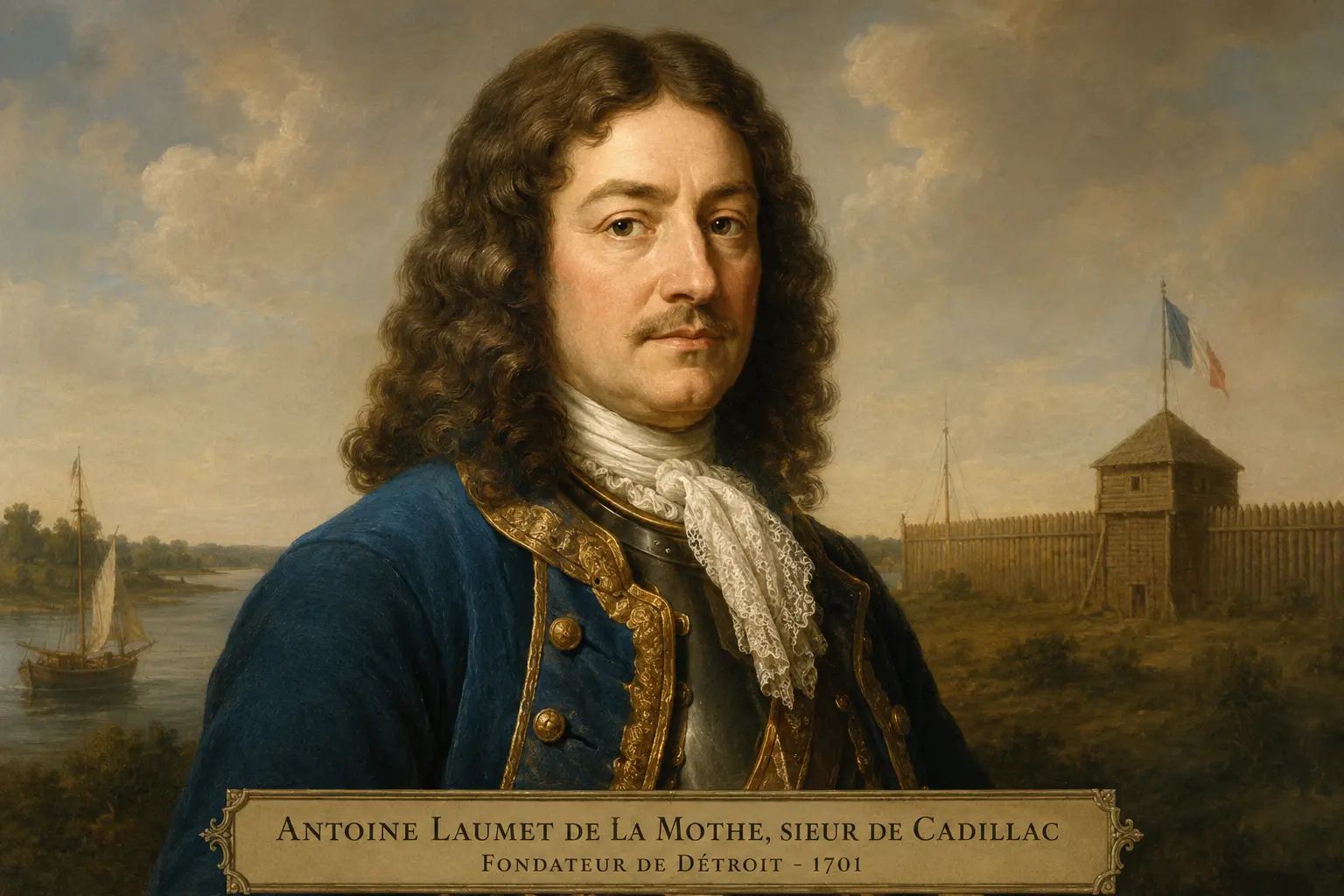
Antoine de la Mothe Cadillac is remembered today as the founder of Detroit, but the man behind that title was born with a different name and a much plainer background than the one he later claimed. He was a French soldier, trader, and colonial administrator who built his career in New France during the late 1600s and early 1700s, and he’s known above all for establishing Fort Pontchartrain du Détroit in 1701 the settlement that grew into the city of Detroit.
What makes his story more interesting than a standard founding myth is that Cadillac wasn’t quite who he said he was. His real name was Antoine Laumet, and the noble identity he built for himself turns out to be one of the more successful acts of self-invention in colonial North American history.
Antoine de la Mothe Cadillac: Quick Facts
| Fact | Details |
|---|---|
| Full name | Antoine Laumet de la Mothe Cadillac |
| Birth name | Antoine Laumet |
| Born | March 5, 1658 |
| Birthplace | Near Saint-Nicolas-de-la-Grave, Gascony, France |
| Died | October 15, 1730 |
| Known for | Establishing the French settlement at Detroit in 1701 |
| Wife | Marie-Thérèse Guyon |
| Major settlement | Fort Pontchartrain du Détroit |
| Later position | Governor of Louisiana |
| Final years | Castelsarrasin, France |
Sources including the Detroit Historical Society and Encyclopedia Britannica converge on March 5, 1658 as his birth date and October 15, 1730 as his death date, though a small number of accounts list his death a day later. Historians also generally agree that a fair amount of what Cadillac said about his own background doesn’t hold up so the rest of this article tries to separate the documented record from the story Cadillac told about himself.
Early Life of Antoine de la Mothe Cadillac
Where Was Antoine de la Mothe Cadillac Born?
Cadillac was born in Gascony, in southern France, near the village of Saint-Nicolas-de-la-Grave. At birth he was named Antoine Laumet, the son of a provincial lawyer who served as a counselor at the parliament of Toulouse. His mother came from a landowning family of comparable, solidly middle-class standing. This was a respectable household, but not an aristocratic one no titles, no coat of arms, none of the nobility that Cadillac would later attach to his name.
Genealogical research tied to his birthplace, now preserved as the Musée Cadillac in Saint-Nicolas-de-la-Grave, confirms this middle-class background, and baptismal records identify him simply as Antoine Laumet. None of the documentation from his early life supports the noble pedigree he began claiming as an adult. That gap between the paper trail and the persona is really the starting point for understanding who Cadillac actually was.
Antoine Laumet Becomes “Cadillac”
The transformation happened around the time of his marriage. When Laumet married Marie-Thérèse Guyon in Quebec in 1687, the church record listed him as Antoine de la Mothe, Sieur de Cadillac, son of a father he described as a counselor and nobleman a title his real father never held. From that point forward, he was known as Cadillac, complete with a self-designed coat of arms and an invented lineage.
Historians who have studied the record closely, including the Dictionary of Canadian Biography, describe Laumet as someone willing to bend the truth freely and note that his noble pedigree was something he simply made up.
Whether it was pure ambition or a practical read on how colonial society worked, the rebranding paid off. A self-styled nobleman had an easier time getting audiences with ministers and commanding forts than a lawyer’s son from Gascony. Cadillac’s later career the commissions, the land grants, the ear of the French court depended in part on people believing a story that wasn’t true.
Cadillac’s Move to New France
Why Did Cadillac Go to North America?
Laumet arrived in New France around 1683, at about 25 years old. He didn’t come as an idealistic explorer looking to map unknown territory he came as a trader working the Atlantic coast, and accounts of this period describe him becoming genuinely skilled at reading that coastline. Some records suggest he was also involved in privateering, seizing cargo from enemy ships, which built connections with merchants and earned him a reputation with government officials back in France.
It’s worth resisting the urge to romanticize this chapter. Cadillac was, first and foremost, an ambitious operator who saw opportunity in trade, land, and political favor, and who used all three to climb. The Canadian Museum of History’s account of his early years in New France treats him as an adventurer whose claims about his own background and military record deserve real scrutiny rather than automatic trust. That skepticism turns out to be warranted for most of his career, not just his name.
Cadillac’s Career in Acadia and New France
Cadillac in Acadia
Cadillac spent his first several years in North America working the Acadian coast, and it was there that he met and later married Marie-Thérèse Guyon, the niece of a trading partner. The marriage connected him to an established merchant family and gave him useful footing in colonial society.
In 1688, he was granted land that included portions of what is now Mount Desert Island in Maine. He built a house there and appears in a local census with his wife that same year. But Cadillac was recalled to France in 1689 to serve as a military advisor and never returned to the island. The estate he might have built there never materialized his ambitions in Acadia essentially stalled out, and the land eventually passed to his granddaughter decades later.
Cadillac at Fort Michilimackinac
Cadillac’s next major post connected him directly to the Great Lakes. He took command of the fort at what is now St. Ignace, Michigan sometimes referred to as Michilimackinac, sometimes as Fort de Buade starting around 1694. It was here that he developed a firsthand understanding of the Great Lakes fur trade and the geography of the region, including the strategic value of the narrow waterway the French called “le détroit,” the strait connecting Lake Erie and Lake St. Clair.
This is the piece of the story that makes the Detroit expedition make sense. Cadillac wasn’t guessing about the Detroit River’s importance he’d spent years watching French and British interests compete for control of Great Lakes trade routes, and he understood that whoever held the strait held real leverage over that trade and over relationships with Indigenous nations in the region.
Why Cadillac Wanted to Establish Detroit
Protecting French Interests
By the late 1690s, French officials were increasingly worried about British traders pushing into territory France considered its own sphere of influence. A fortified settlement on the Detroit River would give France a permanent foothold between Lakes Erie and Huron, making it harder for the British to expand their reach into the western Great Lakes and easier for France to maintain alliances with Indigenous nations in the region.
Expanding the Fur Trade
The location also made economic sense on its own terms. The Detroit River sat along a natural corridor for canoe travel and trade, connecting multiple Great Lakes and the networks of Indigenous and French traders who used them. A post there meant better access to furs and a stronger position for controlling how that trade moved.
Building a Permanent French Settlement
Unlike a seasonal trading post, Cadillac pitched Detroit as something more ambitious: an actual colony, with farming families as well as soldiers and traders. He argued that the surrounding land was well suited to agriculture and pushed the idea of a lasting settlement rather than a temporary outpost that would empty out once the trading season ended.
Cadillac’s Personal Ambitions
None of this happened in a vacuum of pure strategy. Cadillac stood to gain directly from a Detroit settlement land, trading revenue, and a position of real authority in New France. The Detroit Historical Society’s account of his proposal makes clear that he pitched Detroit as a place that would counter British interests while also taking advantage of the region’s trading and agricultural potential, and it’s not hard to see how those same advantages lined up with what Cadillac personally wanted out of his career. Ambition and strategy pointed in the same direction, which is a big part of why he pushed the plan so hard.
Cadillac and the 1701 Expedition
Cadillac Leaves Montreal
Cadillac had gone back to France in 1698 to make his case directly, and King Louis XIV approved the plan. On June 5, 1701, Cadillac departed from Lachine, near Montreal, at the head of an expedition of roughly 100 people soldiers, colonists, missionaries, and Indigenous guides and participants who knew the route.
The Route to Detroit
The expedition’s path followed established water routes rather than cutting new trails: from Lachine up the Ottawa River, across Lake Nipissing, down the French River into Georgian Bay, along Lake Huron, through the St. Clair River, across Lake St. Clair, and finally down the Detroit River itself. It was a demanding but well-known canoe route, one that Indigenous traders had used for generations before Cadillac’s group ever set out.
Arrival at the Detroit River
After weeks of travel, the expedition reached the Detroit River, passing landmarks such as Grosse Île before settling on a specific site for the fort one that offered a defensible position along the water and easy access to trade routes in every direction.
July 24, 1701
On July 24, 1701, Cadillac’s group selected their settlement site and began construction of what they named Fort Pontchartrain du Détroit, honoring the French minister of marine who had approved the expedition. The word “détroit” is simply French for “strait,” a direct reference to the narrow waterway the fort overlooked. This is the date conventionally cited as the founding of what became Detroit.
Fort Pontchartrain and the Origins of Detroit
Did Antoine de la Mothe Cadillac Found Detroit?
In the conventional sense, yes Cadillac is credited with founding Detroit, and that’s the shorthand most sources use. The more precise version is that he led the French expedition that established Fort Pontchartrain du Détroit, the settlement that eventually grew into the modern city.
That distinction matters because the site itself was never empty land waiting to be discovered. Anishinaabe peoples had lived in, traveled through, and relied on the Detroit River region for thousands of years before 1701. The French didn’t found a city out of wilderness; they built a fortified trading post at a location that was already central to Indigenous life and commerce in the Great Lakes.
The Indigenous History of Detroit Before Cadillac
Long before any French sail appeared on the Detroit River, Anishinaabe communities used the strait as a hub for travel, trade, and diplomacy. The river connected a wide network of Indigenous nations across the Great Lakes, and it was this existing infrastructure of relationships and travel routes that made the site so valuable to Cadillac in the first place.
Indigenous guides were part of his 1701 expedition, and Indigenous knowledge of the region shaped where and how the French settlement was built. Treating 1701 as a “discovery” misses this entirely it was a European settlement layered onto a place that already had a long, active history.
Cadillac’s Relationship With Indigenous Peoples
Cadillac’s approach to Indigenous nations was shaped by the same mix of strategy and self-interest that ran through the rest of his career. He actively encouraged Indigenous communities to settle near Fort Pontchartrain, offering protection and access to French trade goods, because a larger Indigenous population around the fort meant more furs, more alliances, and a stronger French position against the British.
That relationship wasn’t uniformly cooperative, though. Records from the period also document conflicts, including disputes tied to trade practices and complaints about how Cadillac and his subordinates dealt with Indigenous partners. The fairest way to describe it is complicated: French colonial strategy depended on real diplomatic and trading relationships with Indigenous nations, and those relationships coexisted with tension, exploitation, and moments of open conflict. Neither a purely cooperative picture nor a purely hostile one captures what actually happened at Detroit in this period.
What Kind of Leader Was Cadillac?
Cadillac doesn’t fit neatly into either the hero or villain category, and historians have landed on very different verdicts about him. On the positive side, he was resourceful, persuasive, and had a genuinely sharp understanding of Great Lakes geography and trade. He got a fort built, kept it running for nearly a decade, and pushed through political resistance in both Quebec and Versailles to make his Detroit plan happen at all.
On the other side, the record includes real controversy. He was accused of abusing his authority as commandant, of self-dealing in the fur and brandy trade, and of conflicts with both traders and colonial officials. The Dictionary of Canadian Biography is particularly unsparing in its assessment, and even sympathetic sources tend to acknowledge the pattern of self-promotion and questionable conduct that followed him throughout his career.
One historian cited in that same entry went as far as calling him one of the worst figures to set foot in New France, while another described him as a genuine hero of early North American history which gives you a sense of how divided the assessments still are.
What Happened to Cadillac After Detroit?
Cadillac governed Fort Pontchartrain until 1710, when opposition from officials in Quebec and Paris led to his removal from the post. Rather than ending his career, though, this pushed him toward a new and even larger assignment.
Cadillac as Governor of Louisiana
Cadillac was named governor of French Louisiana around 1710 or 1711, though he didn’t actually arrive to take up the post until 1713. His time there was rocky Louisiana was a difficult colony to manage, and Cadillac’s leadership style didn’t win him more friends there than it had at Detroit. Accounts differ slightly on the exact end date of his tenure, with some sources citing 1716 and others 1717, but he was ultimately recalled and returned to France. Because Detroit dominates his popular legacy, this Louisiana chapter tends to get overlooked, even though it occupied several important years of his career.
Cadillac’s Death and Final Years
After returning to France, Cadillac was briefly imprisoned in the Bastille amid ongoing disputes tied to his colonial career, though he was later released. He spent his remaining years as governor of Castelsarrasin, a position near his birthplace in Gascony. He died there on October 15, 1730, at the age of 72. Compared to the scale of what Detroit would eventually become, Cadillac’s own reputation at the time of his death was relatively modest his significance would only grow, and shift, in the centuries that followed.
The Legacy of Antoine de la Mothe Cadillac
His Legacy in Detroit
Fort Pontchartrain du Détroit was the seed from which the modern city of Detroit grew, and the City of Detroit itself marks 1701 as the starting point of its European settlement history, crediting Cadillac with establishing that original fort. That doesn’t mean Cadillac built anything resembling the Detroit that exists today French, British, Indigenous, and later American influences all shaped the city over the following three centuries but his name remains tied to its origin story in a way few other figures can claim.
Cadillac Mountain
One of the more surprising threads in Cadillac’s legacy involves a Maine mountain that has nothing directly to do with Detroit. Cadillac’s brief stint holding land on Mount Desert Island in the late 1680s the same period that produced little lasting benefit for him personally eventually earned him a very visible honor: in 1918, what had been known as Green Mountain, the highest point on Mount Desert Island and on the U.S. Atlantic seaboard, was renamed Cadillac Mountain. It’s a legacy Cadillac himself never could have predicted, tied to a colonial venture that mostly fizzled out during his lifetime.
The Cadillac Automobile Connection
The most widely recognized use of Cadillac’s name today has nothing to do with exploration at all. In 1902, William Murphy and Henry Leland founded the Cadillac Automobile Company in Detroit, naming it after the city’s colonial founder as a way of tying the new company to Detroit’s origins. The brand adopted a crest based on the coat of arms Cadillac had invented for himself back in the 1680s a small irony, given that the original crest represented a nobility he never actually possessed. Over the following century, the automobile brand became so dominant in popular recognition that far more people today know the name “Cadillac” from the car than from the historical figure it came from.
Antoine de la Mothe Cadillac: Myths vs. Facts
Myth: Cadillac was born a French nobleman. Fact: He was born Antoine Laumet, the son of a provincial lawyer, and historical records don’t support the noble ancestry he claimed as an adult.
Myth: Cadillac discovered Detroit. Fact: Indigenous peoples had lived in and used the Detroit River region for thousands of years before 1701. Cadillac established a French settlement there he didn’t discover an empty place.
Myth: Cadillac was simply a heroic French explorer. Fact: His career combined genuine achievement with real controversy, including disputes over trade practices, treatment of Indigenous partners, and abuse of his authority as commandant.
Myth: Cadillac only matters because of Detroit. Fact: His name is also tied to Cadillac Mountain in Maine and, much more famously, to the Cadillac automobile brand.
Myth: Cadillac founded the modern city of Detroit. Fact: He established the early French fort and settlement that became the basis for Detroit. The city as it exists today developed over centuries through French, British, Indigenous, and American periods.
Where Does the Name Detroit Come From?
The name traces directly back to the French word “détroit,” meaning strait, referring to the narrow waterway connecting Lake Erie and Lake St. Clair. Cadillac’s fort was formally named Fort Pontchartrain du Détroit, and over time the settlement simply became known by the second half of that name Détroit, later anglicized to Detroit.
Why Was Antoine de la Mothe Cadillac Important?
Cadillac’s importance comes down to a few overlapping factors. Strategically, his Detroit settlement strengthened France’s hold on the Great Lakes at a moment when British competition was intensifying. Economically, it promoted trade and eventually agricultural settlement in a region France badly wanted to control. Politically, his persistence in pushing the Detroit plan through skeptical officials shaped how New France approached westward expansion. And historically, the fort he established became the direct ancestor of one of the largest cities in North America.
None of that requires treating him as an uncomplicated hero. His importance and his contested reputation exist side by side he mattered to the shape of French colonial North America precisely because he was ambitious, persistent, and not always scrupulous about how he got what he wanted.
Timeline of Antoine de la Mothe Cadillac’s Life
- 1658 : Born Antoine Laumet near Saint-Nicolas-de-la-Grave, Gascony
- 1683 : Arrives in New France at around age 25
- 1687 : Marries Marie-Thérèse Guyon in Quebec; begins using the name “de la Mothe Cadillac”
- 1688 : Granted land including parts of Mount Desert Island, Maine
- 1694 : Takes command of the fort at Michilimackinac (St. Ignace, Michigan)
- 1698 : Returns to France to propose a settlement on the Detroit River
- 1701 : Leads the expedition to Detroit
- July 24, 1701 : Fort Pontchartrain du Détroit established
- 1710 : Removed from his Detroit post
- 1710/1711 : Named governor of Louisiana (arrives 1713)
- 1716/1717 : Recalled to France
- 1730 : Dies at Castelsarrasin, France
Sources vary somewhat on the exact years surrounding his Louisiana appointment and departure the general sequence above reflects the most commonly cited dates.
FAQ
Who was Antoine de la Mothe Cadillac?
He was a French soldier, trader, and colonial administrator, born Antoine Laumet, best known for leading the 1701 expedition that established Fort Pontchartrain du Détroit, the settlement that became Detroit.
Was Antoine de la Mothe Cadillac French?
Yes. He was born in Gascony, in southern France, and spent his early life there before arriving in New France in 1683.
What did Cadillac do in 1701?
He led an expedition of roughly 100 people from Montreal to the Detroit River, arriving on July 24, 1701, and establishing Fort Pontchartrain du Détroit.
Did Cadillac actually found Detroit?
He’s credited with founding the French settlement that grew into Detroit. The site itself, however, had been used by Anishinaabe peoples for thousands of years before the French arrived.
Why did Cadillac establish Detroit?
He wanted to protect French interests against British expansion, secure control of Great Lakes fur trade routes, build a lasting agricultural settlement, and advance his own wealth and political standing.
What was Fort Pontchartrain?
It was the fort Cadillac’s expedition built in 1701 along the Detroit River, named after the French minister of marine who approved the expedition. It became the founding settlement of Detroit.
What happened to Cadillac after founding Detroit?
He governed the fort until 1710, then served as governor of Louisiana, later returned to France, spent time imprisoned in the Bastille amid colonial disputes, and finished his life as governor of Castelsarrasin.
Why is Detroit associated with Cadillac?
Because he led the 1701 expedition that established the city’s founding French settlement, and his name has stayed attached to Detroit’s origin story ever since.
Was Antoine de la Mothe Cadillac actually a nobleman?
No. He was born to a middle-class family and invented a noble pedigree, along with a coat of arms, after arriving in North America.
Is the Cadillac car named after Antoine de la Mothe Cadillac?
Yes. The Cadillac Automobile Company, founded in Detroit in 1902, was named after the city’s colonial founder and adopted a crest based on the coat of arms he had designed for himself.
Who was Antoine de la Mothe Cadillac? He was a French soldier, trader, and colonial administrator, born Antoine Laumet, best known for leading the 1701 expedition that established Fort Pontchartrain du Détroit, the settlement that became Detroit.
Was Antoine de la Mothe Cadillac French? Yes. He was born in Gascony, in southern France, and spent his early life there before arriving in New France in 1683.
What did Cadillac do in 1701? He led an expedition of roughly 100 people from Montreal to the Detroit River, arriving on July 24, 1701, and establishing Fort Pontchartrain du Détroit.
Did Cadillac actually found Detroit? He’s credited with founding the French settlement that grew into Detroit. The site itself, however, had been used by Anishinaabe peoples for thousands of years before the French arrived.
Why did Cadillac establish Detroit? He wanted to protect French interests against British expansion, secure control of Great Lakes fur trade routes, build a lasting agricultural settlement, and advance his own wealth and political standing.
What was Fort Pontchartrain? It was the fort Cadillac’s expedition built in 1701 along the Detroit River, named after the French minister of marine who approved the expedition. It became the founding settlement of Detroit.
What happened to Cadillac after founding Detroit? He governed the fort until 1710, then served as governor of Louisiana, later returned to France, spent time imprisoned in the Bastille amid colonial disputes, and finished his life as governor of Castelsarrasin.
Why is Detroit associated with Cadillac? Because he led the 1701 expedition that established the city’s founding French settlement, and his name has stayed attached to Detroit’s origin story ever since.
Was Antoine de la Mothe Cadillac actually a nobleman? No. He was born to a middle-class family and invented a noble pedigree, along with a coat of arms, after arriving in North America.
Is the Cadillac car named after Antoine de la Mothe Cadillac? Yes. The Cadillac Automobile Company, founded in Detroit in 1902, was named after the city’s colonial founder and adopted a crest based on the coat of arms he had designed for himself.






Leave a Reply