

Table of Contents
Who Founded Detroit? The 1701 Founding Explained
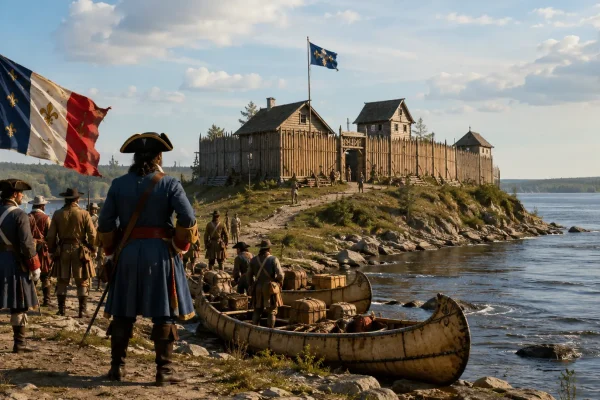
Detroit was founded by Antoine de la Mothe Cadillac, a French military officer and fur trader, on July 24, 1701. Acting under authorization from King Louis XIV, Cadillac led about 100 colonists and soldiers from Montreal to a narrow point along the Detroit River, where they built a fortified settlement called Fort Pontchartrain du Détroit. That outpost grew into the city known today as Detroit, Michigan.
That’s the short answer. The fuller story involves a weeks-long expedition, a calculated military and economic strategy, and a founder whose legacy is still being argued over including in a peer-reviewed study published just a few years ago.
Who Founded Detroit?
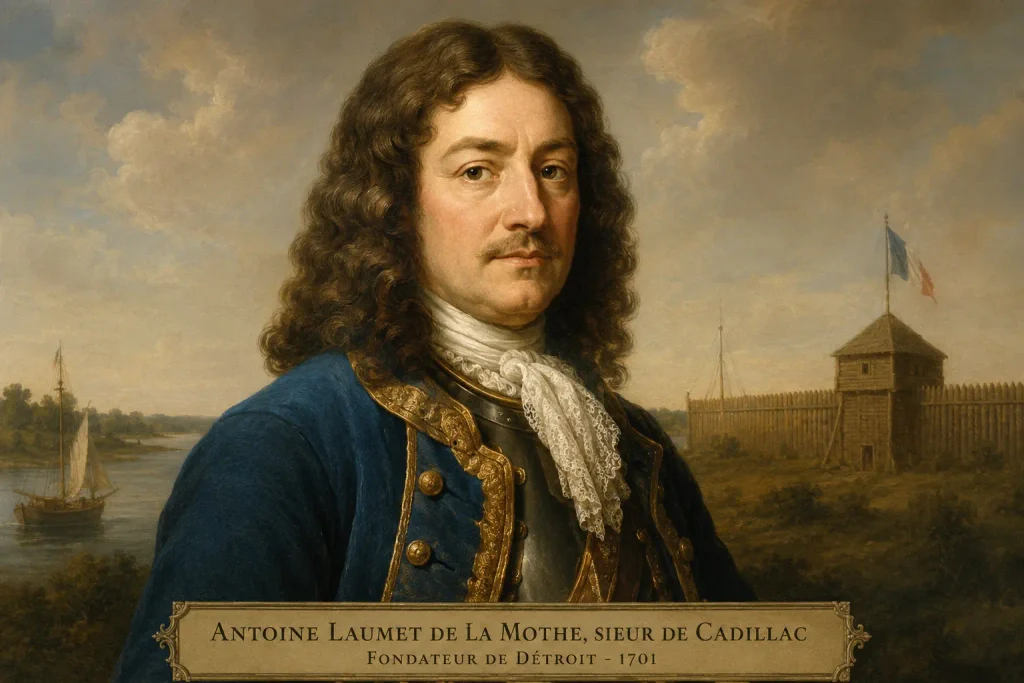
The founder of Detroit was Antoine Laumet, better known by the name he adopted as an adult: Antoine de la Mothe Cadillac. Born on March 5, 1658, in the Gascony region of southern France, Cadillac arrived in New France (French Canada) around age 25 and worked as a coastal trader before entering military service. He commanded the outpost at Michilimackinac, on the straits between Lakes Michigan and Huron, where he built a reputation as a capable frontier officer and, according to the Detroit Historical Society, drew criticism for selling alcohol to Native communities and mistreating fur traders to build his own wealth.
Cadillac didn’t act alone or without royal backing. He needed approval from King Louis XIV and France’s Minister of Marine, Count Pontchartrain, to establish a post farther south. Cadillac argued that a settlement at the narrows of the Detroit River a name that comes from the French le détroit, meaning “the strait” would strengthen France’s hold on the Great Lakes fur trade and check growing British influence to the east. He reportedly envisioned the new post as nothing less than the “Paris of New France.”
The king agreed. In 1701, Cadillac left Michilimackinac to put the plan into action.
When Was Detroit Founded?
Detroit was founded on July 24, 1701. That’s the date Cadillac’s expedition arrived at the chosen site and began building the settlement that would become the city.
The founding was the result of a journey that began weeks earlier. Cadillac and a party of roughly 100 French colonists, soldiers, and missionaries, guided along the way by Native allies, departed from Lachine near Montreal on June 4 or 5, 1701 (accounts vary slightly on the exact date). They traveled by canoe along a chain of rivers and lakes including the Ottawa River, Lake Nipissing, Georgian Bay, Lake Huron, the St. Clair River, and Lake St. Clair before camping at Grosse Ile on the night of July 23 and reaching the final site the next morning.
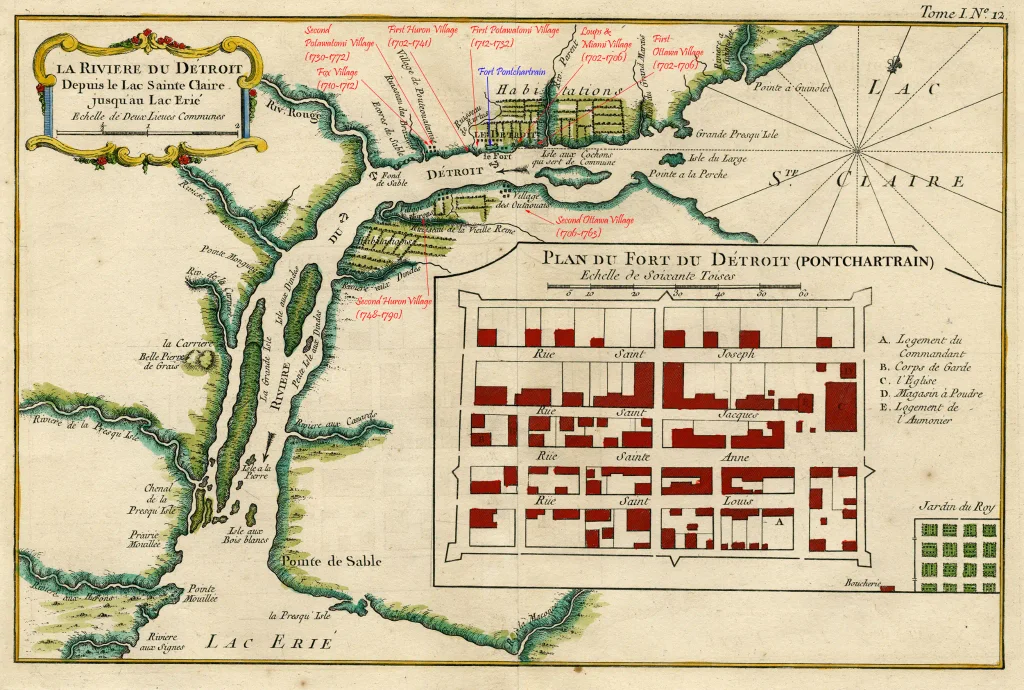
The group landed at a stretch of the river where roughly 40-foot bluffs met the water, near what is now the intersection of West Jefferson and Shelby in downtown Detroit a spot Cadillac had scouted specifically because it was easy to defend. On July 24, they began building what he named Fort Pontchartrain du Détroit, honoring his patron at the French court.
How Did Cadillac Establish Detroit?
Understanding how the settlement came together helps explain why it succeeded where other frontier posts struggled.
What Was the Journey from Montreal Like?
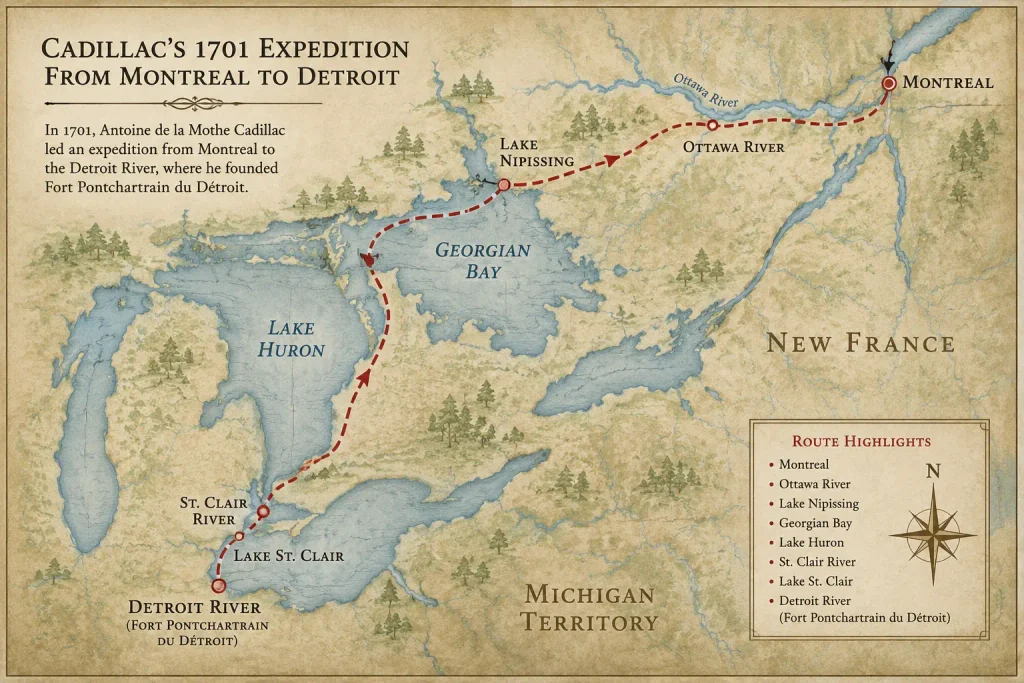
Cadillac’s expedition was not a solo venture. It included about 50 soldiers and 50 civilian colonists, along with missionaries who ministered to both the French and the Native communities they expected to encounter. The party traveled in roughly 25 canoes a mode of transport that required navigating hundreds of miles of interconnected waterways with no margin for delay, since the group needed to build shelter before winter.
This logistical detail matters for anyone trying to picture the scale of the undertaking: founding Detroit wasn’t an act of simply claiming land, but a multi-week expedition that depended on provisioning, coordination with Indigenous guides, and a workable relationship with the nations already living in the region.
How Was Fort Pontchartrain du Détroit Built?
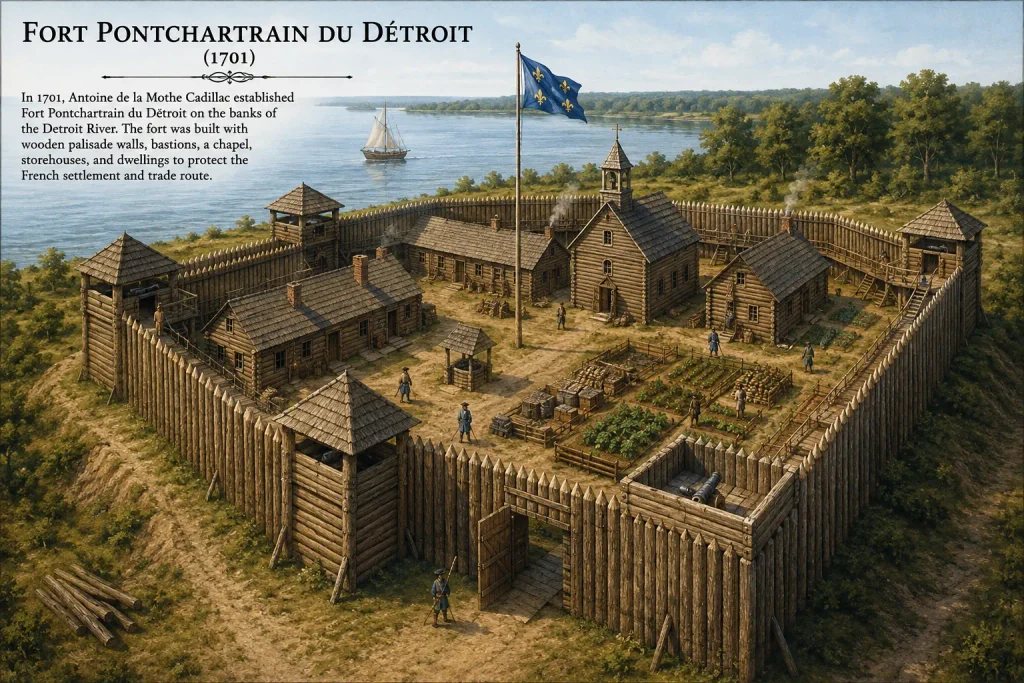
Once the party landed, construction began immediately. The settlers raised a wooden stockade fifteen-foot oak pickets sunk three feet into the ground, enclosing about an acre around a small chapel dedicated to St. Anne, storehouses, and simple dwellings. The name Fort Pontchartrain du Détroit combined the fort’s dedication to Count Pontchartrain with the description of the strait itself.
The settlement’s early population was modest, and Cadillac wasn’t entirely honest about it. According to the Detroit Historical Society, his glowing reports of a thriving colony sent back to Versailles were contradicted by an outside 1708 report that counted just 62 French residents outside the fort’s garrison and noted that Cadillac himself was widely disliked for abusing his authority. Growth stayed slow for decades: a history compiled by Central Michigan University’s Clarke Historical Library notes that by 1740, Detroit’s population of soldiers had actually shrunk, from about 100 armed men at founding to just 17.
Why Did Cadillac Choose This Location?
Cadillac didn’t pick the site at random. The narrows of the Detroit River offered a defensible position, fertile land, and control over a key water route connecting the upper and lower Great Lakes all of which mattered in the ongoing contest between France and Britain for influence over the fur trade and Indigenous alliances in the region.
What Was the Land Like Before Cadillac Arrived?
The site Cadillac chose was not wilderness. The area was already known to Indigenous peoples as Waawiiyaataanong, meaning “where the river bends,” according to the Detroit Historical Society. Nations including the Huron/Wyandot, Odawa (Ottawa), Potawatomi, and Ojibwe had long histories of settlement, travel, and trade throughout the region, and Cadillac’s own expedition depended on Native guides to complete the journey. Once the fort was built, Cadillac actively encouraged Native communities to settle nearby for mutual protection and trade and French and Native families intermarried in the settlement’s early years, though relations between different tribes camped near the fort weren’t always peaceful.
What Is Cadillac’s Legacy in Detroit Today?
Cadillac’s fingerprints are still visible in Detroit well beyond the history books.
Starting in 1707, Cadillac began granting settlers narrow, river-fronting “ribbon farms” that stretched two to three miles inland a land-division pattern whose old boundary lines still echo in the layout of some Detroit streets today, several of which are named for those original French families.
His name is even more visible downtown. The Cadillac Chair, a red sandstone monument erected in 1901 for the city’s 200th founding anniversary, still stands in Cadillac Square. A statue of Cadillac elsewhere in the city depicts him in colonial military dress. And in 1902, when a group of Detroit investors needed a name for a new luxury automobile company built on the site of Cadillac’s old fort, they chose his name and coat of arms which is why the Cadillac brand’s crest today is actually the family crest of Detroit’s founder.
Cadillac’s legacy isn’t purely celebratory, though, and that tension has only grown more public in recent years. A 2022 study published in the journal People and Nature named Cadillac Mountain in Acadia National Park renamed in his honor in 1918 among 254 U.S. place names the researchers argue “memorialize settler colonialism.”
Historians have long been split on the man himself: one biographer called him one of the “great early heroes in North American history,” while another, historian William J. Eccles, described him as “one of the worst scoundrels ever to set foot in New France.” Cadillac governed Detroit until 1710, when disputes with rivals in Quebec and Paris got him reassigned as governor of French Louisiana a posting that went just as poorly, by most accounts, and ended with his brief imprisonment in the Bastille after he returned to France. Historians have also confirmed that his claim to noble birth, embedded in the name “de la Mothe Cadillac,” was fabricated.
Even Detroit’s academic roots run back to him in an unexpected way: in 1703, Cadillac proposed a seminary to educate both French and Indigenous children an idea historians point to as a forerunner of the institution that eventually became the University of Michigan.
Frequently Asked Questions
Who is credited as the founder of Detroit?
Antoine de la Mothe Cadillac is credited as the founder of Detroit. He led the 1701 expedition that established Fort Pontchartrain du Détroit, the settlement that became the city.
What year was Detroit founded?
Detroit was founded in 1701, specifically on July 24 of that year, when Cadillac’s expedition arrived and began building the fort.
Why is Detroit named after a French phrase?
“Detroit” comes from the French le détroit, meaning “the strait,” referring to the narrow stretch of the Detroit River where Cadillac’s party built their settlement.
Did Cadillac found Detroit alone?
No. Cadillac led the expedition, but it included around 100 French colonists, soldiers, and missionaries, plus Native American guides, and the venture required royal approval from King Louis XIV.
Is Detroit named after Cadillac himself?
No. The city takes its name from the French geographic term for the strait. Cadillac’s name was instead given decades later to the Cadillac automobile brand and to a separate city in northern Michigan.
Key Takeaway
Detroit’s founding traces to a single, well-documented event: Antoine de la Mothe Cadillac‘s arrival at the Detroit River on July 24, 1701, with royal backing and a party of roughly 100 colonists and soldiers. What began as a modest fortified outpost, built for strategic and commercial reasons rather than sentiment, grew over the following three centuries into one of the United States’ major cities.
Curious what else shaped Detroit’s early years, or how its French colonial roots still show up around the city today? Explore more Detroit history coverage on the Detroit Weekly News.
Sources consulted
- Detroit Historical Society, Encyclopedia of Detroit: “Cadillac, Antoine de la Mothe” and “Founding of Detroit”
- Encyclopædia Britannica: “Antoine Laumet de La Mothe Cadillac”
- U.S. National Park Service: “Antoine de la Mothe Cadillac”
- Clarke Historical Library, Central Michigan University: “A Brief History of Detroit”
- People and Nature (2022): “Words are monuments: Patterns in US national park place names perpetuate settler colonial mythologies including white supremacy”
- ClickOnDetroit / WDIV: “A look at history behind Detroit statues, monuments”
- Historic Detroit: “Cadillac Chair (Cadillac’s Chair, Chair of Justice)”






Leave a Reply